Quick Summary:
Modern software delivery demands continuous validation instead of isolated testing cycles. As applications become more interconnected and release timelines shorten, organizations are transforming functional testing into continuous quality engineering to improve automation efficiency and production resilience. This blog explores the operational drivers behind this shift, along with its benefits, challenges, automation strategies, and best practices for building scalable quality engineering frameworks.
Table of Contents:
- Introduction
- Why Traditional Functional Testing Models Are Falling Short
- The Shift from Testing to Continuous Quality Engineering
- Key Benefits of Continuous Quality Engineering
- Challenges Organizations Face During the Transition
- Best Practices for Building a Continuous Quality Engineering Strategy
- The Role of Automation and AI in Modern Functional Validation
- Final Thought
Software delivery models have changed significantly over the last decade. Enterprises now release updates weekly, daily, or even multiple times within a single day. Applications are distributed across cloud environments, integrated with third-party platforms, and expected to deliver uninterrupted user experiences across devices and regions. In such environments, isolated testing cycles are no longer sufficient to maintain software stability and deployment reliability.
This transformation is forcing organizations to reconsider what functional testing is in software and how it contributes to software quality across modern delivery pipelines. Instead of validating functionality only at the end of development, businesses now require continuous verification across every phase of engineering. This is where the concept of continuous quality engineering becomes increasingly important.
The shift is not simply about increasing automation coverage. It reflects a broader operational change in how quality is measured, maintained, and embedded into software delivery. Teams are combining observability, risk analysis, automated validation, production monitoring, and intelligent test execution into a connected quality strategy. As a result, traditional functional testing is expanding into a continuous engineering discipline designed to support speed, scalability, and resilience simultaneously.
ImpactQA combines automation and continuous quality engineering to accelerate stable releases.
Why Traditional Functional Testing Models Are Falling Short
For years, enterprises relied on sequential testing models where development was completed first, followed by dedicated validation cycles before deployment. While this structure worked for slower release schedules, it creates operational pressure in modern agile and DevOps-driven environments. Businesses cannot afford prolonged testing cycles when customer expectations and market demands require rapid feature delivery.
One major challenge lies in the growing complexity of enterprise applications. A single transaction may now pass through APIs, cloud services, databases, authentication systems, analytics engines, and third-party integrations. Traditional software functional testing approaches often struggle to validate these interconnected workflows efficiently because testing remains limited to predefined stages rather than continuous verification.
Several operational issues commonly emerge from older testing structures:
Delayed Defect Identification
When validation occurs late in the development cycle, defects become more expensive and time-consuming to resolve. Teams spend additional effort tracing dependencies, reworking code, and conducting repeated regression cycles.
Inconsistent Test Coverage
Applications change rapidly across multiple releases. Manual validation often fails to keep pace with evolving business logic, resulting in coverage gaps and missed production risks.
Environment Instability
Modern systems depend heavily on microservices and distributed architectures. Traditional testing environments frequently fail to replicate production behavior accurately, reducing the reliability of test outcomes.
Increased Release Bottlenecks
When testing remains centralized within a single phase, deployment pipelines slow down significantly. Development teams wait for approvals, regression execution, and issue resolution before moving releases forward.
Limited Production Visibility
Conventional testing models focus primarily on pre-production validation. However, many performance issues, integration failures, and workflow inconsistencies appear only after deployment under real user conditions.
These limitations are changing how organizations approach functional testing in software testing. Enterprises now require quality practices that operate continuously instead of periodically. This demand is accelerating the move toward integrated quality engineering frameworks capable of supporting dynamic release ecosystems.
The Shift from Testing to Continuous Quality Engineering
Continuous quality engineering extends beyond the boundaries of traditional testing activities. Instead of treating quality as a verification step, organizations integrate quality controls into every layer of software delivery, from requirement analysis to production monitoring.
This shift is strongly connected to the adoption of agile development, CI/CD pipelines, cloud-native systems, and intelligent automation frameworks. In such environments, quality teams are expected to support rapid iteration while maintaining software stability and delivery reliability.
The transition can be understood through several operational changes.
Sr. No. |
Traditional Testing Approach |
Continuous Quality Engineering |
| 1. | Testing occurs after development | Quality validation begins early |
| 2. | Manual-heavy execution cycles | Automation-driven workflows |
| 3. | Limited production monitoring | Continuous observability |
| 4. | Isolated QA ownership | Shared quality responsibility |
| 5. | Static regression suites | Dynamic risk-based testing |
| 6. | Periodic reporting | Real-time quality insights |
One important aspect of this transformation is the increasing use of functionality testing software that integrates directly with CI/CD environments. Modern tools can automatically trigger validations during code commits, infrastructure changes, and deployment activities. This reduces dependency on manual intervention while improving release speed.
Another major shift involves collaboration. Continuous quality engineering removes the traditional divide between developers, testers, operations teams, and business stakeholders. Quality becomes a collective engineering objective rather than the sole responsibility of QA teams.
Organizations are also prioritizing predictive quality analysis. Instead of waiting for failures to occur, teams analyze code changes, defect history, production telemetry, and user behavior to identify high-risk areas proactively. This approach allows businesses to focus on testing efforts more effectively while reducing unnecessary execution overhead.
The growing use of automated functional testing software is further supporting this transition. Intelligent automation frameworks can execute thousands of validations continuously across browsers, devices, APIs, and enterprise systems without interrupting delivery timelines. This capability is particularly important for large organizations managing complex digital ecosystems.
Key Benefits of Continuous Quality Engineering
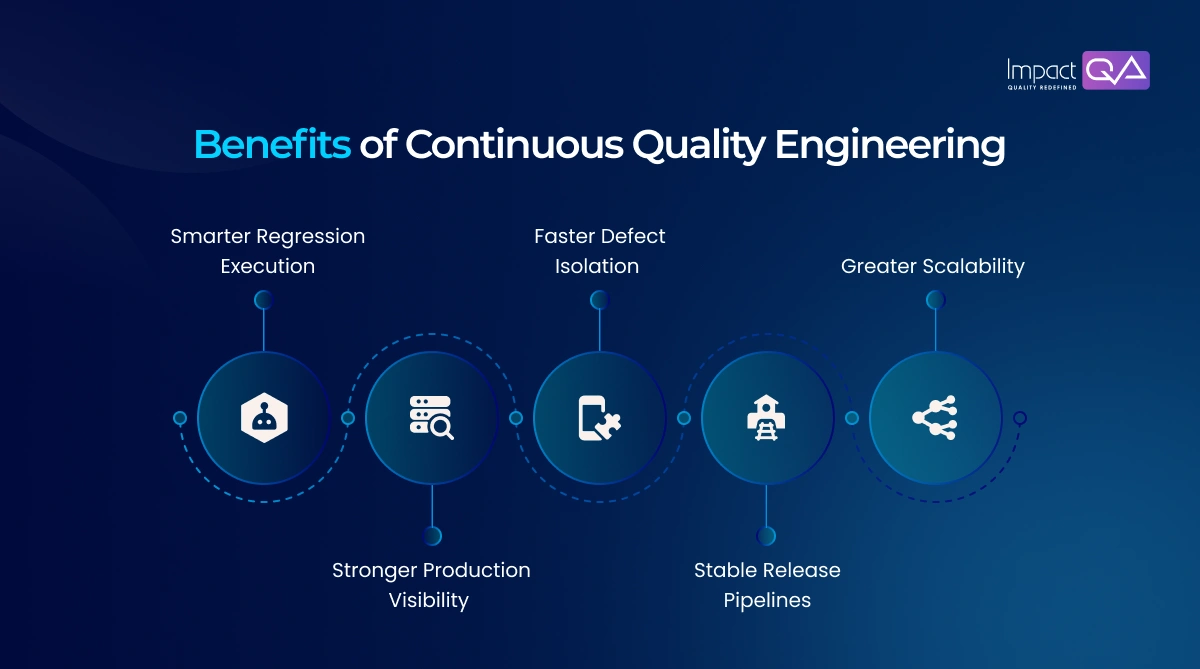
Organizations adopting continuous quality engineering frameworks are observing measurable improvements across software delivery, operational stability, and customer experience. The benefits extend far beyond faster testing execution.
Smarter Regression Execution
Continuous quality engineering improves regression efficiency by prioritizing validations based on application impact, code changes, and business-critical workflows. Instead of repeatedly executing static test suites, organizations use intelligent automation to focus on high-risk areas within deployment pipelines.
Stronger Production Visibility
Continuous monitoring provides deeper visibility into application behavior across APIs, cloud environments, and enterprise integrations. Teams can identify transaction failures, service disruptions, and performance inconsistencies before they affect end users.
Faster Defect Isolation
Automated validation pipelines execute tests immediately after code commits and configuration changes. This allows teams to detect defects earlier in the delivery cycle, reducing remediation effort and minimizing deployment delays.
Stable Release Pipelines
Continuous validation strengthens delivery stability by verifying integrations, workflows, and infrastructure dependencies throughout CI/CD pipelines. This reduces the probability of failures during high-frequency release cycles.
Greater Scalability
Continuous quality models scale more effectively across cloud-native architectures, distributed systems, and enterprise integrations. This flexibility is becoming increasingly important as businesses modernize digital operations through intelligent automation and connected delivery ecosystems.
The expansion of functional testing services within enterprise transformation initiatives reflects this growing demand. Organizations are seeking testing partners capable of supporting automation engineering, DevOps integration, AI-driven validation, and continuous quality monitoring within unified delivery ecosystems.
Challenges Organizations Face During the Transition
Although the shift toward continuous quality engineering delivers substantial operational value, many enterprises face implementation challenges during adoption.
Legacy Infrastructure Constraints
Older enterprise systems may not support automated integration or continuous deployment frameworks effectively. Teams often struggle to modernize validation workflows without disrupting existing business operations.
Tool Fragmentation
Many organizations operate disconnected testing, monitoring, and reporting platforms. This fragmentation reduces visibility and creates inconsistencies across quality operations.
Skill Gaps
Continuous quality engineering requires expertise beyond manual testing execution. Teams need knowledge in automation architecture, CI/CD integration, observability platforms, cloud systems, and data analysis.
Test Maintenance Complexity
As applications scale, maintaining automated validation frameworks becomes increasingly difficult. Poorly structured automation suites create instability, false positives, and execution delays.
Cultural Resistance
The transition also requires organizational mindset changes. Some teams continue viewing quality as a separate function rather than an integrated engineering responsibility.
Best Practices for Building a Continuous Quality Engineering Strategy
Enterprises building mature quality engineering frameworks often follow several foundational practices that support scalability and long-term stability.
Shift Validation Earlier
Quality activities should begin during requirement analysis and development planning. Early validation reduces downstream defects and improves development efficiency.
Build Stable Automation Foundations
Automation frameworks should prioritize maintainability, modular design, reusable components, and environment consistency. Poor automation architecture increases maintenance costs over time.
Integrate Quality into CI/CD Pipelines
Testing should be executed continuously throughout deployment workflows instead of relying solely on scheduled validation cycles.
Prioritize Risk-Based Testing
Not every workflow requires identical execution frequency. Organizations should identify business-critical functions and focus on validation efforts strategically.
Strengthen Production Monitoring
Quality engineering should extend beyond pre-release validation. Monitoring user behavior, transaction health, and operational metrics provides deeper visibility into real-world system performance.
Use Data for Quality Decisions
Analytics-driven reporting improves defect forecasting, release readiness evaluation, and quality trend analysis across delivery pipelines.
The Role of Automation and AI in Modern Functional Validation
Automation is no longer limited to scripted regression execution. AI-enabled quality engineering platforms are introducing adaptive testing models capable of improving efficiency and decision-making across software delivery pipelines.
Modern AI-driven validation platforms can:
- Prioritize high-risk workflows based on code changes and dependencies
- Detect UI modifications and adjust impacted test scenarios automatically
- Reduce false-positive failures through intelligent execution analysis
- Optimize regression suites for faster and focused validation cycles
- Generate predictive insights for release readiness and quality risks
These capabilities are changing the structure of software validation significantly. Instead of maintaining static testing workflows, organizations are building intelligent quality ecosystems capable of adapting to application changes continuously.
AI is also improving the operational value of functional testing services by reducing repetitive maintenance efforts and increasing execution reliability. This becomes particularly important for enterprises operating large-scale ERP platforms, cloud-native applications, and distributed enterprise environments.
At the same time, human expertise remains essential. Engineering teams still play a critical role in business workflow analysis, risk interpretation, governance alignment, and strategic quality planning. AI supports acceleration, but engineering judgment continues to guide quality direction.
ImpactQA delivers intelligent functional testing services for faster and more stable deployments.
Final Thought
Continuous quality engineering represents a structural shift in how organizations approach software reliability and operational resilience. Businesses now do not depend solely on isolated validation cycles when software ecosystems are expanding across cloud infrastructure, APIs, intelligent applications, and rapid deployment pipelines. As delivery timelines shorten, enterprises require integrated quality strategies that combine automation, monitoring, analytics, and engineering collaboration into a unified operational model. This transition is redefining the future of functional testing and placing greater emphasis on continuous validation throughout the software lifecycle.
At ImpactQA, we deliver specialized functional testing services that support agile delivery, enterprise modernization, and continuous quality engineering initiatives. Our teams specialize in validating complex business workflows across cloud platforms, ERP environments, APIs, and interconnected enterprise ecosystems. We apply continuous testing and automation-led quality engineering practices to help organizations maintain application stability and strengthen quality governance across complex digital ecosystems.
Share this post


Related Posts
Our Case Studies