What Makes Shift Left and Shift Right Testing Essential in Modern Quality Engineering

Quick Summary:
System failures are often triggered by real-world conditions that controlled testing environments are not designed to replicate. Shift-left vs shift-right testing addresses this disconnect by extending validation beyond development. This blog explains how a structured shift-right testing approach, combined with shift-right testing with AI, helps teams validate system behavior under real operating conditions and make more precise, evidence-backed release decisions.
Table of Contents:
- Introduction
- What is the Role of Shift-Left vs Shift-Right Testing
- Why Shift-Right Testing Strengthens Production Readiness
- Advancing Quality with Shift-Right Testing with AI
- What are the Key Challenges in Adopting a Shift-Right Testing Approach
- What are the Strategic Practices for Scalable Quality Engineering
- Bottom Line
A system that passes functional validation can still struggle when exposed to concurrent transactions, uneven data loads, or dependency delays. These are not edge cases; they are routine conditions in production environments. The gap is not always in test coverage, but in how and where validation is performed. When testing remains confined to controlled scenarios, it often overlooks how systems behave when multiple variables interact at scale.
This is where shift-left vs shift-right testing becomes structurally important. Early validation ensures that logic, integrations, and workflows are built correctly, while a shift-right testing approach examines how those same components behave under live conditions. When extended with shift-right testing with AI, this model allows teams to interpret production signals with greater precision. Together, these practices redefine quality engineering as a continuous validation process grounded in actual system behavior rather than assumed performance.
ImpactQA enables predictive validation and intelligent monitoring for complex systems.
What is the Role of Shift-Left vs Shift-Right Testing
The concept of shift-left vs shift-right testing defines how quality is distributed across the software lifecycle. Instead of concentrating testing at a single stage, it ensures that validation begins early and continues after deployment. This creates a continuous feedback loop that connects development efforts with real-world system behavior.
Shift-left testing embeds validation into development workflows, strengthening code quality through unit and integration checks while enabling faster feedback and reducing rework. However, it relies on simulated data and controlled environments, limiting its ability to capture unpredictable user behavior, variable workloads, and complex third-party interactions. As systems grow more distributed and data-intensive, these gaps become more pronounced, leaving performance, resilience, and user experience insufficiently validated under real-world conditions.
To address these limitations, shift-right testing extends validation beyond controlled environments into production or production-like settings. A structured shift-right approach captures how applications behave under real traffic, user interactions, and external dependencies, closing the gap between expected performance and actual system behavior.
Early Defect Prevention vs Real-World Validation
Shift-left testing identifies defects during development, ensuring that workflows and logic are validated before release. In contrast, shift-right testing evaluates how the system performs under actual user conditions, where performance and reliability are critical.
Controlled Environments vs Dynamic Conditions
Pre-release testing relies on stable datasets and predefined scenarios. A shift-right testing approach exposes systems to unpredictable traffic patterns, integration failures, and network variability that cannot be replicated earlier.
Static Validation vs Continuous Feedback
Shift-left testing validates functionality through predefined scenarios in controlled environments. In contrast, shift-right testing enables continuous feedback by analyzing real usage, system behavior, and performance under dynamic, real-world conditions.
Developer-Centric vs User-Centric Validation
Early testing ensures functional correctness from a development perspective. Shift-right testing evaluates user experience, including response times, transaction success rates, and system stability.
By combining both approaches, organizations move beyond isolated testing cycles. They establish a continuous validation model where quality is not only built into the system but also verified under real operating conditions.
Why Shift-Right Testing Strengthens Production Readiness
Production environments introduce complexities that are difficult to simulate during pre-release testing. These include concurrent user activity, real-time data processing, and dependencies on external systems. Without validating these factors, systems may appear stable in testing but fail under actual usage.
Shift-right testing focuses on validating behavior where it matters most. It ensures that applications can handle real workloads, maintain performance consistency, and recover from unexpected disruptions. This makes it essential for systems that operate at scale.
A structured shift-right testing approach includes several critical validation methods:
Production Monitoring and Observability
Systems are continuously monitored to capture performance metrics, error rates, and transaction flows. This provides visibility into real-time behavior and helps detect issues early.
Canary Releases and A/B Testing
Features are released to a limited user base before full deployment. This allows teams to evaluate performance and impact in a controlled manner.
Chaos Testing and Failure Simulation
Systems are exposed to controlled disruptions to evaluate resilience. This helps identify weaknesses that may not appear during standard testing.
User Behavior Analysis
Real user interactions are analyzed to understand how systems are used. This helps identify performance bottlenecks and areas for improvement.
Advancing Quality with Shift-Right Testing with AI
As systems become more complex, traditional monitoring and analysis methods are no longer sufficient. This is where shift-right testing with AI adds significant value. By combining real-time data with intelligent analysis, organizations can move from reactive issue detection to proactive quality management.
Shift-right testing with AI enables systems to identify patterns, detect anomalies, and predict potential failures. This transforms testing into a continuous intelligence-driven process rather than a periodic validation activity.
Key capabilities include:
Predictive Failure Analysis
Historical and real-time data are used to predict potential failures. This helps teams take preventive action before issues impact users.
Automated Root Cause Identification
AI-driven analysis correlates multiple data points to identify the source of issues quickly. This reduces the time required for investigation and resolution.
Dynamic Test Optimization
Testing strategies are adjusted based on insights derived from system behavior. This ensures that validation efforts focus on high-risk areas.
A shift-right testing approach combined with AI also improves decision-making. Teams can rely on data-driven insights rather than assumptions, which enables more accurate prioritization and faster resolution of issues.
This integration is particularly valuable for systems with high transaction volumes and complex workflows. It ensures that quality engineering remains effective as system complexity increases.
What are the Key Challenges in Adopting a Shift-Right Testing Approach
Adopting a shift-right testing approach requires organizations to extend testing into production environments while maintaining system stability. This transition introduces operational and technical complexities that go beyond traditional testing practices. Managing real-time data, ensuring controlled validation, and aligning teams with new processes are critical factors that influence success.
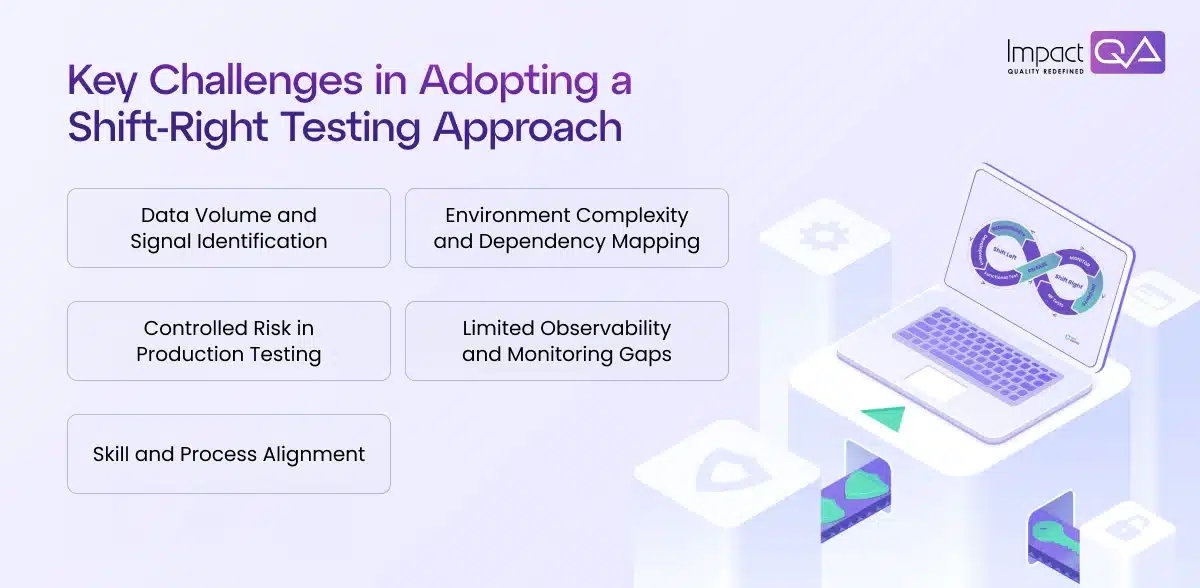
Data Volume and Signal Identification: Production systems generate large volumes of logs, metrics, and user activity data. Identifying meaningful insights from this data requires structured filtering and analysis. Without this, teams may struggle to distinguish critical issues from noise.
Environment Complexity and Dependency Mapping: Modern systems rely on multiple interconnected services and third-party integrations. A shift-right testing approach must account for these dependencies in real time. Incomplete visibility can lead to gaps in validation and missed failure points.
Controlled Risk in Production Testing: Testing in live environments carries the risk of affecting users. Techniques such as canary releases and feature toggles help minimize this risk. Without proper controls, validation efforts can impact system performance and user experience.
Limited Observability and Monitoring Gaps: Effective shift-right testing depends on strong observability practices. Inadequate monitoring reduces visibility into system behavior, making it difficult to detect anomalies and analyze performance issues.
Skill and Process Alignment: Teams need expertise in monitoring, data analysis, and automation to implement a shift-right testing approach effectively. Aligning these capabilities with existing workflows can be challenging, but it is necessary to achieve consistent results.
What are the Strategic Practices for Scalable Quality Engineering
Implementing shift-left vs shift-right testing effectively requires a structured approach that connects development validation with production insights. Organizations must move beyond isolated testing efforts and adopt practices that ensure continuous quality across the lifecycle. This involves aligning tools, processes, and teams to support scalable validation.
Lifecycle-Integrated Testing: Testing should begin early in development and continue after deployment. This ensures continuous validation and reduces gaps between stages.
Observability-Driven Validation: Monitoring and logging should be integrated into testing strategies. This provides real-time insights into system behavior and performance.
Automation for Scale and Consistency: Automated testing and monitoring improve efficiency and reduce manual effort. They enable teams to validate complex systems consistently.
Feedback Loop Integration: Insights from shift-right testing should be fed back into development processes. This helps address issues at the source and improve system design.
AI-Driven Quality Intelligence: Incorporating shift-right testing with AI enables predictive analysis and faster issue resolution. This improves both efficiency and accuracy in validation efforts.
These practices ensure that quality engineering remains consistent and scalable as systems grow in complexity. By combining early validation with real-world insights, organizations can build systems that perform reliably under diverse conditions.
ImpactQA combines early validation with production insights to deliver scalable testing solutions.
Bottom Line
Quality engineering cannot rely on validation that ends at release. Systems must be assessed across their full operational lifecycle, where performance, stability, and behavior are influenced by real usage conditions. Shift-left vs shift-right testing brings this continuity by combining early defect control with production-level validation. A structured shift-right testing approach ensures that systems are not only built correctly but also remain stable when exposed to concurrency, integrations, and variable workloads.
Extending this model with shift-right testing with AI allows teams to interpret productive signals with greater accuracy and respond with precision. ImpactQA applies this approach through integrated testing, performance validation, and intelligent monitoring. This enables organizations to move from periodic testing cycles to continuous data-driven quality assurance that supports stable and reliable system performance.
Share this post


Related Posts
Our Case Studies