Why Leading Healthcare Software Testing Companies Are Shifting Focus to Compliance-Driven Automation

Quick Summary:
Compliance has moved from a back-office concern to a front-line priority for healthcare software testing. The rise in cloud adoption, tighter regulations, and data vulnerability have made it non-negotiable to build automation frameworks with compliance at their core. This blog examines the significance of cloud security in healthcare, key regulatory requirements, the advantages of compliant automation, and how ImpactQA facilitates smarter, more secure, and compliant testing.
Table of Contents:
- Introduction
- Compliance as a Driving Force in Automation
- The Importance of Cloud Security in Healthcare
- Key Regulations Influencing Automation Strategy
- Benefits of Compliance-Driven Automation
- Why Healthcare Testing Companies Are Rebuilding Automation Frameworks
- The Role of ImpactQA in Delivering Secure Compliance Testing
- Conclusion
Healthcare software is under immense pressure today. From patient data to diagnostic records, the risk of data exposure has significantly increased. Manual testing, though once dependable, can no longer keep up with the speed and complexity of modern healthcare applications.
Automation fills this critical gap. But now, it’s not just about speed or efficiency. The demand has shifted to secure, traceable, and regulation-aligned automation. Why? Because every click in a healthcare app could potentially expose sensitive personal information.
Think of Electronic Health Records (EHR), remote patient monitoring apps, or AI-powered diagnostic platforms. These systems require rigorous testing that tracks every action, encrypts all data, validates workflows, and proves regulatory compliance. This is the level where automation must now evolve.
Compliance no longer remains about documentation. It’s about continuous, active validation at every stage of the testing cycle. Healthcare apps must now pass through HIPAA, GDPR, and FDA filters – all while operating across multiple dynamic cloud platforms. As a result, testers are rethinking and rebuilding their strategies. They are scripting smarter, embedding real-time checks, and automating detailed audit trails.
Let’s explore how this growing compliance-first mindset is reshaping healthcare test automation.
Let ImpactQA run a full compliance scan for you.
Compliance as a Driving Force in Automation
Regulations now directly shape how healthcare software behaves. They govern data access, usage, audit logs, and system responses. Missing even a single step in this chain could result in steep fines or worse actual harm to patients.
This is precisely why modern automation strategies now include compliance logic at their core. Scripts today don’t just test functional features; they actively test legal and regulatory correctness.
For example, in EPIC software testing, a simple patient log entry must show exactly who accessed it, when they did so, and for what purpose. These details must also be encrypted, stored securely, and remain traceable. Automated tests are now expected to verify all of that consistently.
Modern testing frameworks, particularly those using CI/CD pipelines, are evolving to include:
- Real-time compliance validations
- Continuous regulatory audit logging
- Identity verification test cases
- Secure access and authorization validation
Each automation cycle now produces a detailed trail of evidence. This includes logs, screenshots, test workflows, and accurate timestamps that document every action. What was once considered extra documentation has now become a critical part of the testing process.
Healthcare providers, pharmaceutical companies, and medical device testers expect these compliance reports to be available from the very beginning. No organization wants to face a last-minute rush to fix overlooked violations after a product goes live.
This shift highlights a broader transformation, where compliance is no longer treated as an afterthought. It has become a core driver of automation, shaping how tests are designed, executed, and validated from the ground up.
The Importance of Cloud Security in Healthcare
Cloud adoption in healthcare is booming. But with this shift comes risk. Systems become more susceptible to data breaches, misconfigured servers, and insecure APIs. Nearly 90% of healthcare organizations reported a data breach in the last 24 months. That’s not just statistics, it’s a crisis.
Key threats:
- Unprotected storage buckets
- Poor access controls
- Outdated encryption
- Weak third-party API validation
To counter this, automation must include:
- IAM policy validation
- Secure API endpoint testing
- Role-based access control testing
- Encryption audit scripts
Modern testing frameworks are evolving to support built-in security validation. With healthcare applications often deployed across multiple cloud environments, it’s essential to run compliance checks specific to each platform’s security requirements.
Cloud security no longer comes under the “nice-to-have” category. Without integrating security protocols into your test automation process, meeting regulatory standards becomes extremely difficult if not entirely unachievable.
Key Regulations Influencing Automation Strategy
Smart test strategies are evolving to reflect the weight of regulatory demands. Compliance checks are now embedded as core components of the automation blueprint. It’s a shift toward precision where every test run isn’t just about functionality, but about proving security, accountability, and data integrity by design.
Let’s break down the regulatory pressure shaping automation:
- HIPAA – Controls patient data privacy in the US
- GDPR – Focuses on personal data protection across the EU
- FDA 21 CFR Part 11 – Regulates digital health records and e-signatures
- ISO/IEC 27001 – Covers information security practices
- HITECH Act – Expands HIPAA security and privacy rules
Each of these introduces strict rules. For example:
- HIPAA demands access logs and encryption
- GDPR requires consent logs and the right to erase data
- FDA checks audit trail completeness and digital identity management
Automation must validate these. That includes:
- Consent flow testing
- Encryption standard checks (AES-256)
- Secure login and session tracking
- Dynamic threat modeling
Benefits of Compliance-Driven Automation
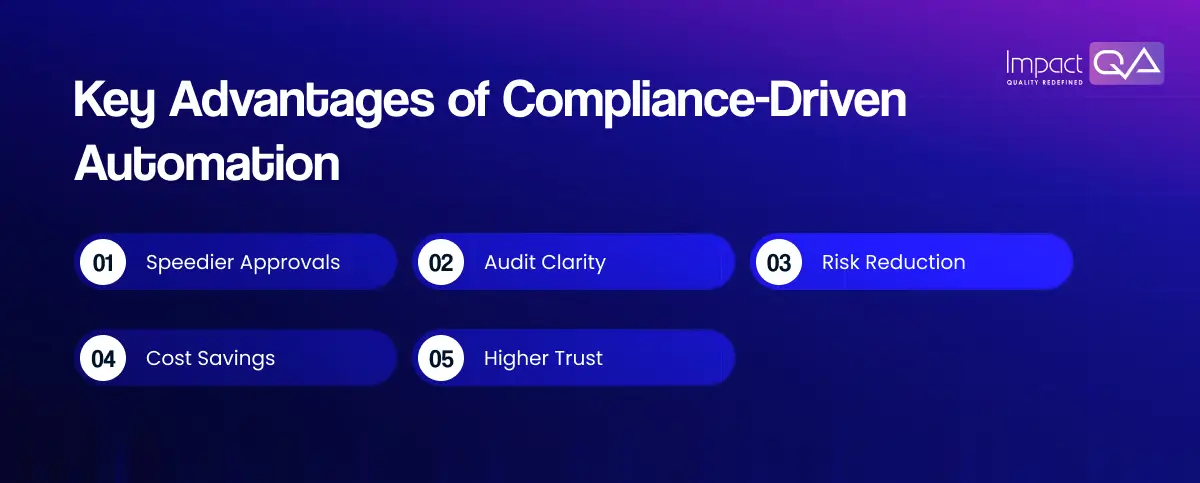
When compliance becomes part of the testing foundation, the advantages extend far beyond checklists. Healthcare teams gain both strategic control and operational confidence.
- Speedier Approvals: Releases aligned with compliance standards move faster through internal reviews and regulatory checks. This helps teams deliver updates and features without unnecessary holdups.
- Audit Clarity: Automatically generated logs and reports provide clear, structured proof of compliance activities. Auditors get what they need without manual data collection or scrambling.
- Risk Reduction: Automated tests catch security gaps, misconfigurations, or policy violations in the early stages. This reduces the chances of post-deployment failures or breaches.
- Cost Savings: By preventing rework, delays, and penalties, compliance-focused testing cuts overall development costs. It transforms testing from a cost center to a strategic investment.
- Higher Trust: Systems that follow strict compliance protocols earn greater trust from patients, regulators, and partners. This trust directly contributes to reputation and long-term adoption.
Why Healthcare Software Testing Companies Are Rebuilding Automation Frameworks
Legacy frameworks don’t work anymore. They lack modularity, traceability, and compliance logic. That’s why testing teams are building hybrid frameworks:
- Modules for GDPR, HIPAA, and FDA scenarios
- Auto-healing scripts for dynamic elements
- Cloud-native test environments
- Dashboards showing compliance status
- Compliance as Code integrated into DevSecOps
This transformation is essential for domains like Medical Device Testing, Hospital Clinical System Testing, and Pharmaceutical Testing workflows, where precision and regulatory adherence are non-negotiable. These areas demand granular testing capabilities and clear audit trails to ensure compliance with evolving standards.
Modern frameworks offer configurable modules tailored to specific regulations by region or service type. Cloud-native setups ensure scalable, consistent testing across distributed teams. Real-time dashboards provide continuous visibility, linking test results directly to compliance checklists. This guarantee focused, traceable testing with documented proof.
Ultimately, healthcare automation now goes beyond running tests – it delivers precise, compliant, and auditable processes that evolve with complex regulatory demands.
The Role of ImpactQA in Delivering Secure Compliance Testing
At ImpactQA, we specialize in delivering healthcare software testing solutions that are secure, compliant, and future-ready. Our automation frameworks are built to align with HIPAA, GDPR, and FDA, offering full-spectrum support for Electronic Health Records (EHR), telehealth platforms, diagnostic systems, and EPIC software.
We also provide focused testing support for patients, providers, and insurance data systems to validate the accuracy, completeness, and consistency of sensitive healthcare information.
Our core quality solutions include:
- Medical Device Testing – Comprehensive simulation-based validation for surgical, dental, and cardiology devices.
- Hospital Clinical System Testing – Evaluation of clinical databases, reporting modules, and drug compliance systems.
- Pharmaceutical Testing – End-to-end testing of pharma applications for security, performance, and interoperability.
- EPIC Software Testing – Verification of appointment workflows, patient records, and billing modules.
To support this, we leverage a powerful stack of automation tools like Selenium, Appium, Postman, and Tosca integrated into cloud-native and CI/CD environments. Combined with our AI-powered risk modeling and real-time compliance dashboards, we deliver testing that is not only fast and scalable but also auditable, traceable, and regulation-ready at every level of the healthcare ecosystem.
ImpactQA has automation solutions built just for you.
Conclusion
Compliance is now a central part of healthcare software testing. Teams must build automation that supports security, auditability, and regulation from the ground up. Every test cycle should validate encryption, access control, and data integrity across cloud environments. This reduces the risk of breaches, penalties, and release delays. A strong compliance-first strategy also improves trust among patients, providers, and regulators.
Companies like ImpactQA offer structured testing solutions that align with global standards. Our frameworks ensure healthcare systems are secure, accurate, and prepared for evolving legal requirements. Smart automation leads to safer healthcare outcomes and stronger digital systems.
Share this post


Related Posts
Our Case Studies