Why Automated Regression Testing in Banking Is a Must for Every Software Update

Quick Summary:
Frequent software updates in banking demand reliable, repeatable, and fast testing cycles. Manual methods fall short when dealing with compliance, security, and high-volume transactions. This blog explains why automated regression testing in banking is essential to maintaining quality and continuity after every change. We break down the challenges, benefits, implementation best practices, and how tailored solutions by ImpactQA can help.
Table of Contents:
- Introduction
- What Triggers the Need for Regression Testing in Banking?
- The Risk of Manual Regression in Financial Systems
- Key Benefits of Automated Regression Testing in Banking
- Test Automation Strategy: What Banks Should Focus On
- Common Banking Modules That Require Regression Testing
- Choosing the Right Tools and Frameworks
- ImpactQA’s Role in Banking QA Automation
Modern banking relies heavily on software systems that are updated frequently to keep up with compliance mandates, digital services, and cybersecurity demands. Each update can lead to unexpected side effects. Even a minor tweak in one module can break functionality in another. Without a repeatable, consistent way to verify past features, the chances of failure grow. That’s precisely when automated regression testing in banking proves essential. It ensures that existing functionality remains stable after changes, helping institutions reduce risk, manage costs, and deliver stable services to users.
Manual regression testing struggles with scale, especially in banking environments where systems are integrated, data-heavy, and governed by strict regulations. Time constraints and complex workflows make it difficult to verify functionality quickly. Automated regression testing not only supports speed but also improves accuracy and consistency. It helps banks maintain control over continuous changes while improving delivery timelines.
Partner with ImpactQA for custom regression test automation across your banking ecosystem.
What Triggers the Need for Regression Testing in Banking?
Banking software systems undergo changes frequently due to internal enhancements, industry regulations, and technology integrations. Each change creates a ripple effect, touching interconnected modules and third-party systems. These changes are not isolated and can impact everything from transaction workflows to reporting accuracy. The sheer complexity of these systems makes regression testing a mandatory step in every update cycle.
Sr. No. |
Change Event |
Impact on Systems |
Why Regression Testing is Needed |
| 1. | Compliance Update | Alters workflows or reporting logic | Ensures data reporting and validation remain intact |
| 2. | Third-Party Integration | Adds external APIs or payment modules | Validates interaction with legacy modules |
| 3. | Security Patch | Changes access controls and encryption layers | Verifies that core transactions still process safely |
| 4. | UI Enhancements | Modifies the front-end components | Checks that business logic behind UI stays consistent |
| 5. | Feature Rollout | Introduces new banking products or tools | Makes sure existing features remain unaffected |
These events show how often and how easily software functionality in banking can be disrupted. Regression testing plays the role of a checkpoint, ensuring the foundation remains intact regardless of changes made.
The Risk of Manual Regression in Financial Systems
Manual regression testing may appear cost-effective at the start, but it proves insufficient as the software system scales. Banks operate through layered workflows involving customer data, financial records, real-time analytics, and security protocols. Each time a new code is introduced, there is a risk of backward compatibility issues. Manual testing cannot address these quickly enough.
Here are the major risks:
- Delayed Testing Cycles: Manual methods take more time to execute, extending the QA timeline and delaying releases.
- Inconsistency: Manual testers may skip or misinterpret steps, especially with lengthy test cases.
- Lack of Coverage: Teams may prioritize visible functionalities while ignoring hidden or backend processes.
- Scalability Challenges: More features mean more tests. Manual testing cannot grow at the same speed as development.
- Ineffective Reporting: Manual test results are harder to track and analyze over time, limiting test intelligence.
Key Benefits of Automated Regression Testing in Banking
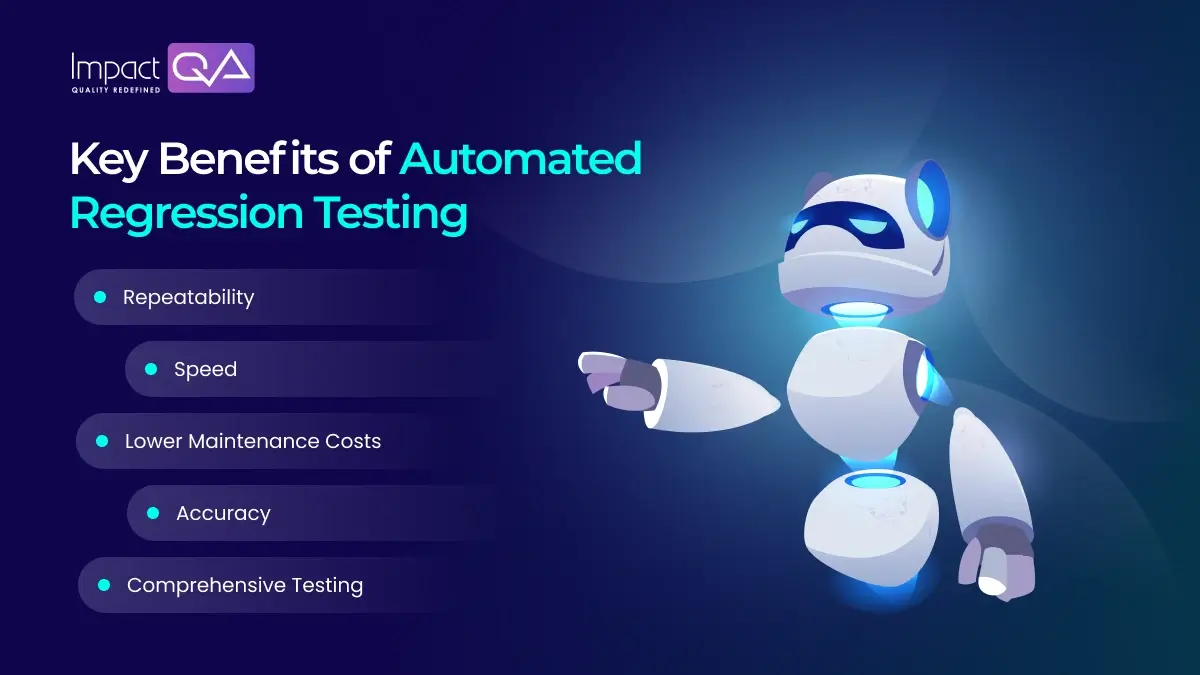
Automation brings a set of practical advantages for banks dealing with regular updates and heavy data workloads. Regression testing through automation not only validates existing functionalities but also boosts overall software confidence before going live.
Key Advantages:
- Repeatability: Automated tests execute in the same order and format every time.
- Speed: Complete regression suites can run in hours instead of days.
- Scalability: As the codebase grows, automation scales with it without proportional cost.
- Lower Maintenance Costs: Once written, test cases can be reused with minimal updates.
- Accuracy: Eliminates the chance of human oversight and missed scenarios.
- Comprehensive Testing: Supports test execution for both frontend and backend systems.
Automation also supports overnight test runs and integration with CI/CD pipelines, helping testers catch regressions early. This early detection of defects reduces the number of post-release bugs and production issues.
For financial software platforms, where even small errors can lead to large transaction mismatches or compliance risks, automation gives QA teams the agility and control they need to deliver secure and reliable updates.
Test Automation Strategy: What Banks Should Focus On
An automation strategy that works for a banking enterprise is not about simply selecting a tool and writing scripts. It requires alignment with business processes, data privacy guidelines, and system complexity. Here is how banks should approach it:
1. Prioritize High-Risk Areas
Start with features that are critical to business operations, such as fund transfers, KYC validations, or loan approvals. These modules often involve multiple systems and are frequently impacted by changes.
2. Modular Test Design
Design reusable test components that can be applied across different test scenarios. This saves effort and improves consistency.
3. Data-Driven Testing
Banking workflows rely heavily on data. Tests should include various data types, conditions, and customer scenarios to improve robustness.
4. Security-Conscious Testing
Banking systems deal with sensitive information. Automate test cases to validate user roles, encryption mechanisms, and access rights.
5. Integrate with CI/CD Pipelines
Automated tests should trigger with every code push, helping QA teams catch issues early in the development cycle.
Common Banking Modules That Require Regression Testing
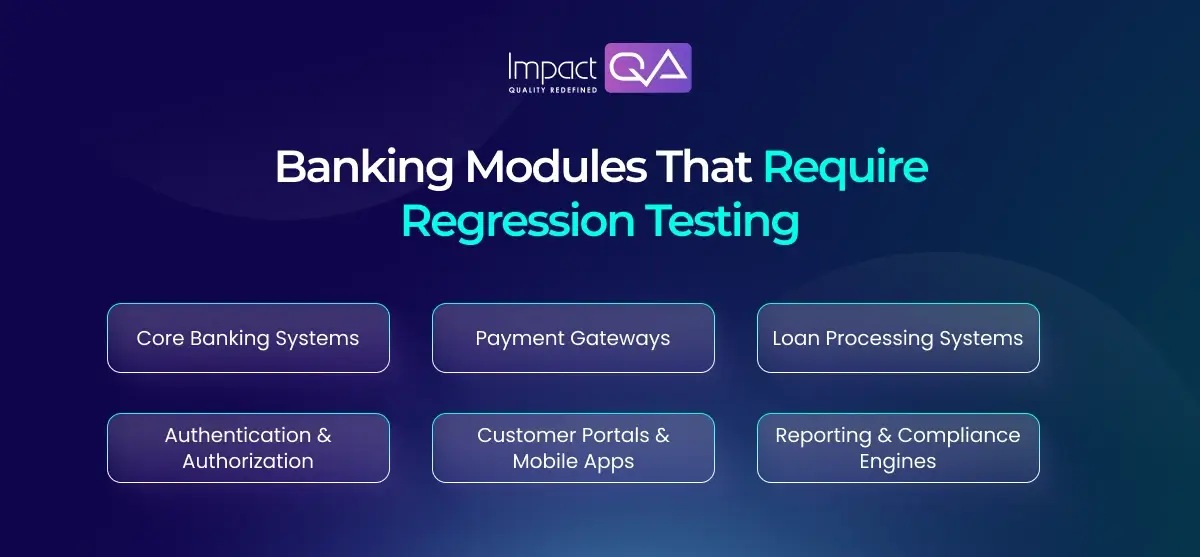
Regression testing should be prioritized in modules that frequently change or are directly tied to business-critical workflows. In banking systems, the following components require special attention:
- Core Banking Systems: Includes account setup, maintenance, and balance tracking. Any regression here can affect a customer’s primary interaction.
- Payment Gateways: UPI, NEFT, RTGS, card payments, and third-party integrations. These are highly dynamic and prone to frequent changes.
- Loan Processing Systems: Changes in rules, interest rates, or repayment structures can impact the backend logic.
- Authentication & Authorization: These affect security protocols, including OTP, biometric checks, and MFA. Regression bugs here can lead to breaches.
- Customer Portals & Mobile Apps: UI changes, performance upgrades, or third-party tools can impact these interfaces.
- Reporting & Compliance Engines: Regulators often introduce new data formats or fields, requiring consistent revalidation.
Regression tests across these modules help ensure that small tweaks or improvements don’t negatively affect core functionality. With each area deeply interconnected, automation adds an assurance layer that maintains system stability.
Choosing the Right Tools and Frameworks
Tool selection in banking is influenced by integration capabilities, scalability, ease of maintenance, and data sensitivity. While open-source options like Selenium are common, commercial tools provide extended functionalities that might suit banking needs better.
Sr. No. |
Tool |
Strength |
Ideal For |
| 1. | Selenium | Cross-browser testing, flexibility | Web-based banking platforms |
| 2. | Appium | Real device mobile testing | Banking apps on iOS and Android |
| 3. | Katalon Studio | Built-in CI/CD integration | End-to-end testing across multiple platforms |
| 4. | Robot Framework | Keyword-driven testing | Data-heavy banking workflows |
| 5. | Cypress | Frontend-focused JavaScript automation | Customer-facing portals |
Security and audit compliance are key. Choose tools that support encrypted environments, integrate with Git-based repositories, and allow role-based test execution. Frameworks must support versioning, parallel execution, and provide actionable reports that QA leaders and developers can use in real time.
ImpactQA’s automated frameworks keep your financial systems always release-ready.
ImpactQA’s Role in Banking QA Automation
Automated regression testing in banking plays a crucial role in preserving the integrity of digital systems. As applications expand and features evolve, so does the complexity of ensuring stability across every touchpoint. With every update, automation provides the reliability and control needed to maintain consistent performance, making it an essential part of modern banking operations.
ImpactQA understands the challenges of banking systems. Our QA engineers work closely with banking clients to build custom regression suites, scalable test automation frameworks, and secure test data management systems. These solutions are tailored to work across core banking software, customer portals, and compliance engines.
With specialized offerings in banking QA and test automation services, ImpactQA enables:
- Domain-specific test coverage for financial workflows
- 24/7 test execution and on-demand regression run
- Secure, compliant, and audit-ready test environments
- Frameworks compatible with CI/CD and DevOps setups
Whether your institution uses Finacle, Temenos, or a custom-built platform, ImpactQA delivers automation that brings measurable results.
Share this post


Related Posts
Our Case Studies