Quick Summary:
Across the oil and gas industry, software now sits in the middle of most operational risk. Much of that risk shows up where control systems hand their data over to business platforms. In this guide, we look at the four software layers involved and three research themes worth watching for 2027. We then cover six testing practices that help keep oil and gas industry software solutions dependable.
Table of Contents:
- Introduction
- 4 Software Layers Where Operational Risk Lives in the Oil and Gas Industry
- 3 Research Themes Shaping Oil and Gas Software in 2027
- 6 Software Testing Practices That Reduce Operational Risk in Oil and Gas
- Final Say
- FAQs
By 2027, American crude output should reach roughly 14.3 million barrels a day, going by the U.S. Energy Information Administration’s latest forecast. Each of those barrels gets measured at the wellsite and counted again when it’s sold and settled, and software is involved at every step in between.
For the oil and gas industry, operational risk is the exposure that builds up along that chain through people, processes and the systems tying them together. A field crew might feel it as downtime or a safety incident. Finance tends to feel it later, as an accounting break, and the security team as an intrusion.
Testing is how teams get ahead of it, by checking with every release that data moves between systems the way it’s supposed to. AI pushes the stakes higher. McKinsey puts near-term upstream AI value at about $65 billion a year, and those models are only as good as the data feeding them.
ImpactQA helps oil and gas companies assess integration risks and prioritize testing across enterprise applications.
Here’s where that risk tends to sit, and how we’d test for it.
4 Software Layers Where Operational Risk Lives in the Oil and Gas Industry
Most oil and gas companies run four software layers side by side, and the translation between them is where most operational risk begins.
1. Control Systems and Process Historians
SCADA (Supervisory Control and Data Acquisition) collects readings from remote sites such as wellheads, compressor stations and pipeline valves. Inside a refinery unit or any single facility, that job falls to a DCS, or Distributed Control System, which keeps continuous processes running.
Both systems need a way to talk to field devices, and that’s what communication protocols are for. Modbus has been around for decades. It hands over values through numbered registers, and what each register actually means is written down somewhere else, in the integration configuration. OPC UA (Open Platform Communications Unified Architecture) is the newer option. Its information models are richer, so a single value can arrive with its engineering unit, timestamp and data-quality status attached. Set it up properly and you also get authentication and encryption.
Then there are tags. A tag names one measured variable, like the discharge pressure on Compressor 4. The process historian keeps every timestamped reading for each tag, often millions a day, and holds onto them for years. In a lot of setups, that historian data travels through middleware into production accounting and ERP volumes.
Why does this matter? Picture a firmware upgrade that quietly shifts a Modbus register map. Suddenly a pressure value gets read from the wrong address. Or take a historian set to local time that feeds an ERP booking in UTC. One day’s production ends up split across two accounting dates. Both look minor at first glance. Once that data reaches financial reporting, though, it lands in the accounting records.
2. ERP and Hydrocarbon Accounting
On the business side, ERP solutions for oil and gas industry operations, such as SAP S/4HANA and Oracle E-Business Suite or Fusion, look after maintenance and finance. Plenty of operators pair them with specialist hydrocarbon accounting tools.
Oil expands as it warms, which is why those tools exist. Hydrocarbon accounting converts measured volumes to standard conditions using the applicable standards. One common reference is the set of API MPMS Chapter 11 tables, which express crude and refined product volumes at 60°F.
Joint venture accounting comes next. Volumes or values get allocated by each partner’s contractual working interest, and royalty calculations follow whatever each lease says. If a conversion or allocation slips, you’ll usually see it in partner statements and settlements within a single monthly close.
3. Trading and Risk Platforms
E/CTRM (Energy and Commodity Trading and Risk Management) platforms such as Openlink Endur, RightAngle and Allegro run the commercial side. Traders capture deals there, and risk teams value open positions at current market prices, a process called mark-to-market.
Timing matters most at this layer. A terminal ticket that arrives a few hours late can leave a trader hedging a position that has already moved. Everything that helps ETRM software benefit the oil and gas industry depends on field data arriving on schedule.
4. Safety and Environmental Systems
EHS (Environment, Health and Safety) platforms are where permit-to-work and management of change (MOC) records live. MOC itself is the formal review and approval process that any proposed change to equipment, processes or procedures has to pass through.
These records have to line up with ERP maintenance work orders. Imagine the MOC approval runs a step behind the work order it’s meant to govern. A crew could walk away with a permit for equipment whose configuration has already changed. Checking that sync gives operators extra support for the process-safety controls they already run.
The takeaway? Test every application, yes. But pay special attention to the handoffs, where tags, volumes and timestamps move from one platform into another, because errors there travel into downstream reports and business transactions.
3 Research Themes Shaping Oil and Gas Software in 2027
Research published across 2025 and 2026 points to three themes, each changing what oil and gas companies need to test in 2027.
1. AI Adoption Adds New Behaviors to Validate
Gartner expects 40% of enterprise applications to include task-specific AI agents by the end of 2026. In 2025, that figure was under 5%. It’s a steep climb, and for oil and gas companies it means new behavior to validate with every agent. Picture one that raises maintenance requests. It has to choose the correct asset, route the request for approval and leave a log of each step.
The prize is big. McKinsey’s August 2026 analysis puts near-term AI value in upstream oil and gas at about $65 billion a year, and up to $230 billion at full potential. Yet the same analysis found fewer than one in five deployments track AI-generated value as a shared KPI. Measuring that value well needs two things: tested data pipelines and model validation. That’s where AI solutions in oil and gas meet enterprise software.
2. IT and OT Convergence Raises Cyber Exposure
Dragos’ 2026 OT Cybersecurity Year in Review tracked 119 ransomware groups targeting industrial organizations in 2025, up from 80 a year earlier. Average ransomware dwell time in OT environments reached 42 days. Organizations with comprehensive OT visibility detected and contained incidents in an average of five days.
Dragos found poor IT/OT segmentation in 29% of the oil and gas reports it analyzed, the highest proportion among the sectors covered. The testing objective follows: confirm that only permitted communications cross between network zones.
3. Downtime Carries a Heavy Price
Siemens’ True Cost of Downtime 2024 report puts the annual cost of unplanned downtime for Fortune Global 500 companies at $1.4 trillion. Oil and gas gets a closer look in the 2022 edition, which drew on 2021–22 research. Losses came to $149 million a year per facility, 76% higher than two years earlier, and oil prices climbed over the same stretch.
Those are big numbers to plan around. On the software side, a good share of the protection comes from performance and failover testing done well before a release goes live.
6 Software Testing Practices That Reduce Operational Risk in Oil and Gas
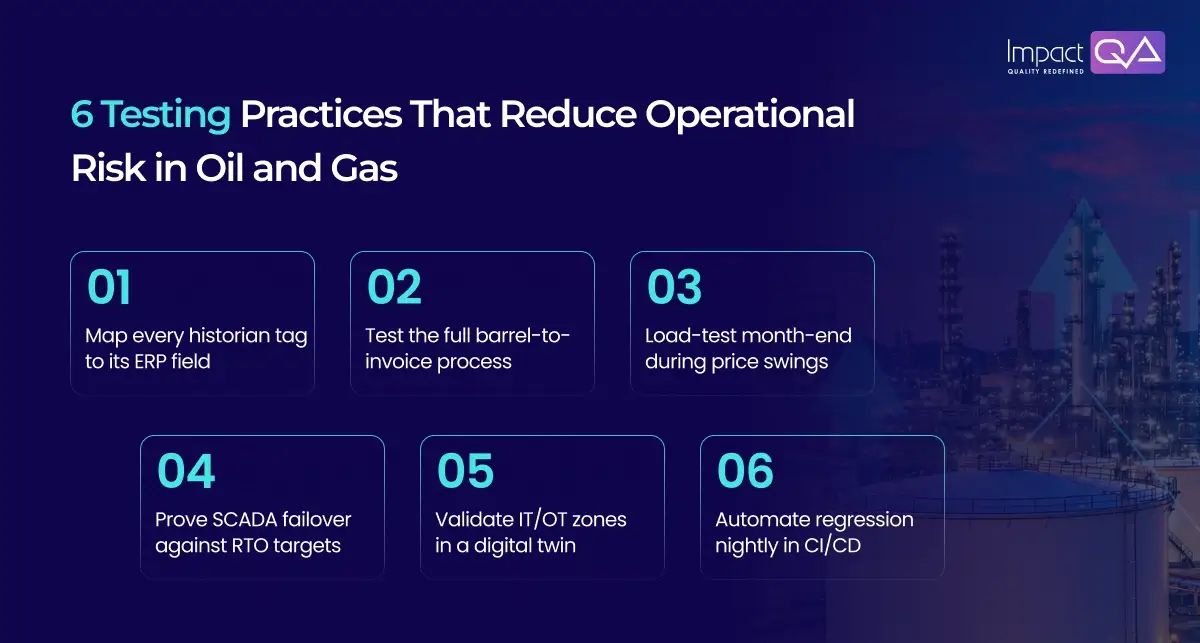
Each practice targets one seam and ties it to a business outcome, forming a program oil and gas industry solutions teams can run every release.
1. Interface and Data Integrity Testing
Start with a tag-to-field map, a document that links every historian tag to the exact ERP field it feeds. Replay a representative production day through each interface, using masked data, and compare standard volumes against meter tolerance.
For APIs, contract tests confirm that each system still sends data in the format its partner expects. Reference data deserves its own suite, since one duplicated location code can double a day’s receipts. The result is accurate volumes in accounting and fewer manual reconciliations. ImpactQA’s API testing services cover this layer.
2. End-to-End Scenario Testing With Representative Data
End-to-end testing confirms that the complete business process works as one. A typical scenario follows a barrel through nomination and ticketing, then into settlement and joint venture allocation.
Test data should mirror production patterns, including real contract structures and month-end volumes, with sensitive fields masked. That realism surfaces issues well ahead of go-live. On large transformation programs, oil and gas companies need independent SAP testing services for exactly this reason.
3. Performance and Failover Testing
A good load test copies a real peak. Month-end close, say, landing in the middle of a sharp price move. Measure response time at every hop along the way.
Control-room systems sometimes fall within scope. When they do, failover testing happens in a controlled environment, with the OT owners in the room. You trigger the switchover in a hot-standby server pair and then check two numbers. One is the recovery time objective (RTO), which sets how quickly operations resume. The other is the recovery point objective (RPO), which sets how recent the restored data must be. ImpactQA’s performance testing services support this work.
4. Security Testing for Connected IT and OT
IEC 62443 gives industrial networks a simple structure. Assets with shared security needs are grouped into zones, and the approved communication paths between those zones are called conduits. What QA teams check is everything crossing a conduit: interfaces, permissions, data flows.
All of this runs in a replica environment or a digital twin, essentially a virtual copy of the control network, which keeps live controllers out of scope. Deeper assessments of the control systems themselves? Those stay with the OT security team.
5. Safety and Compliance Workflow Validation
Test every MOC approval against its linked work order. For emissions, trace the data reported under the EPA’s Greenhouse Gas Reporting Program, Subpart W, back to source records and applicable calculations.
Validate audit trails too, since regulators ask who approved each change, and when. The practices that let SAP testing solutions strengthen safety and compliance apply directly here.
6. Regression Automation and AI Model Checks
SAP feature packs and E/CTRM patches each arrive on their own product-specific release schedule. Plan regression testing around those releases and any configuration changes that ride along with them. Then rank workflows by safety and financial impact. Automate the top group first, and let it run every night in your CI/CD pipeline.
AI is speeding up this part of the job. According to Gartner, 70% of enterprises will have integrated AI-augmented software testing tools into their engineering toolchain by 2028, up from about 20% in early 2025. Testing the AI models themselves calls for a risk-based approach. Keep watching for input drift, and measure performance against representative evaluation datasets.
Once a release ships, look at three things: defect leakage, reconciliation breaks and regression coverage. They tell you where to point your next round of tests.
ImpactQA's CTRM/ETRM test automation framework keeps trading workflows covered, and NeX-AI speeds up test creation.
Final Say
Reliable oil and gas operations come down to accurate data moving across industrial systems, ERP platforms and trading applications. At ImpactQA, that’s the work we do for oil and gas companies. We validate SAP and Oracle applications, test E/CTRM workflows such as trade capture, pricing and risk models, and automate regression with our CTRM/ETRM Test Automation Framework and NeX-AI test generation.
Integration, performance and migration testing protect legacy connections during modernization. And as investment in energy solutions for oil and gas industry operations shifts toward connected operations and AI, tested data will decide how much of that value actually reaches the balance sheet.
Frequently Asked Questions (FAQs)
Share this post


Related Posts
Our Case Studies