Navigating SAP Greenfield Key Implementation Challenges in QA Processes

Quick Summary:
SAP Greenfield implementations offer organizations the chance to build a fresh ERP system but come with unique challenges in maintaining quality assurance throughout the project lifecycle. This blog explores the common QA challenges organizations face in such implementations and provides strategies to overcome them, thus ensuring smooth deployment and post-deployment success.
Table of Contents
- Comprehensive Requirement Gathering
- Integration Testing Complexity
- Data Migration Accuracy
- Customization and Enhancement Validation
- Performance Testing
- Security Testing
- User Acceptance Testing (UAT)
- Continuous Monitoring and Improvement
- Testing in Agile SAP Greenfield Environments
- Post-Deployment Testing and Support
SAP Greenfield implementations provide organizations with an exciting opportunity to create a new ERP landscape from scratch. While this freedom can often feel like a blank slate for the system’s design, as there’s no legacy system to contend with, this approach also comes with its fair share of complexities. How can organizations, therefore, ensure their new SAP system is integrated, error-free, and efficient across all business processes? It’s much more than just developing a system that closely aligns with business goals; it is about keeping in mind quality assurance along the way, until post-deployment.
Let ImpactQA ensure a smooth, error-free implementation.
Effectively, this means providing a massive amount of QA processes to ensure successful Greenfield implementation. With no legacy data or workflows, it’s fraught with unique challenges that threaten to derail project schedules, performance, and user acceptance. To address these challenges, organizations must draw upon well-tested testing frameworks, active partnerships, and thoughtful execution planning along the course of the implemented program. Let’s delve deeper into the key QA challenges faced during SAP Greenfield projects and explore strategies to overcome them.
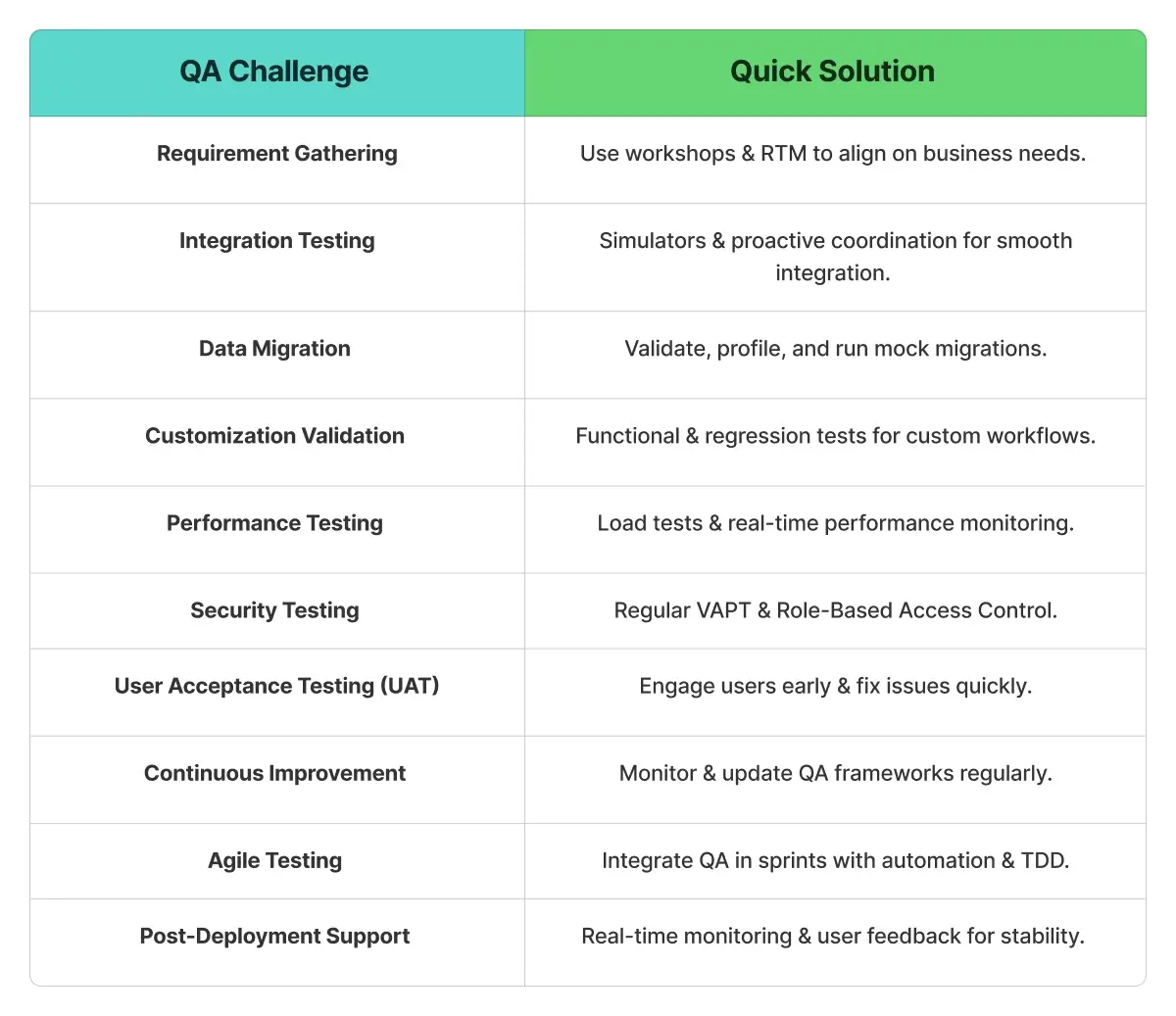
1. Comprehensive Requirement Gathering
Challenge: One of the initial and critical steps in any SAP Greenfield implementation is gathering comprehensive requirements from all stakeholders. This needs really great efforts to get details about workflows, data flow, and interface with different departments and systems. Misunderstanding or overlooking requirements can lead to gaps in the system that may require costly rework later. These unplanned efforts also lead to delays in implementation and increases overall project deadline and cost overrun.
Solution: Employ a comprehensive and robust requirements management process that involves detailed planning, workshops, interviews, and surveys with all relevant stakeholders. Document and validate these requirements meticulously to ensure a common understanding and alignment. Replaying these captured requirements and getting sign-off from the business helps to formalize the scope and get buy in from different stakeholders. Once finalized these requirements can be tracked in RTM (Requirement Traceability Matrix) for any gap till delivery.
2. Integration Testing Complexity
Challenge: SAP systems often need to integrate with a myriad of other applications, whether they are third-party systems, custom-built solutions, or cloud-based services. A few examples of such systems are CRM, Databases, Finance, Procurements, Vendor systems, payroll, etc. Sometimes these systems have their proprietary interfaces, data types, communication channels, and record formats. Ensuring seamless integration is a complex task that requires thorough testing. Another layer of complexity is added by the fact the non-availability of such systems in end-to-end environments in the early stages of testing, which makes it difficult to test these systems comprehensively.
Solution: Design & develop a comprehensive integration testing strategy that includes end-to-end test scenarios covering all potential interactions. Utilize simulators/emulators of these systems in a controlled way in the initial phases of testing and perform end-to-end integration tests in later stages of testing. Here the focus would be to have communication lines working for various systems owners for debugging issues related to their systems to achieve faster resolution of integration issues. If coordination is not done proactively, the chances of a project getting delayed are higher. Try to utilize automated testing tools to streamline repetitive tasks and ensure thorough coverage.
3. Data Migration Accuracy
Challenge: Migrating data from legacy systems to the new SAP environment is fraught with risks, including data loss, corruption, and inaccuracies. Ensuring data integrity during migration is paramount. Most of the time we may find data discrepancy in AS IS System and TO BE System in terms of data definition, size, quality. There might be a need for creating a data warehouse and getting it processed before putting it into SAP system, again increasing complexity and adding cost to entire data fabric.
Solution: Implement a data migration testing plan that includes data profiling, validation, and reconciliation. Create a data check plan at each point to identify any data change, loss, or unintended modifications. Perform mock migrations to identify potential issues and address them before the actual migration. Data security and privacy are of utmost importance at this stage and should be tested thoroughly.
4. Customization and Enhancement Validation
Challenge: As each business is different for its organization, therefore SAP Greenfield implementations often require significant customization to meet specific business needs. Validating these customizations to ensure they function correctly and do not introduce new issues is crucial. The test cases are to be customized enabling organization-specific implementation of the workflows.
Solution: Develop a thorough & rigorous functional and regression testing approach for all customizations. Test cases are to be reviewed by business SME and operations team to ensure there are no gaps in test coverage with reference to customized business flows. Use a combination of manual and automated testing to validate both the functionality and performance of these enhancements. The focus should be on increasing automation coverage for each regression cycle.
5. Performance Testing
Challenge: The performance of the system is very important for creating a great user experience. Ensuring the new SAP system can handle the expected load and perform optimally under various conditions is essential. Performance issues can lead to user dissatisfaction and operational disruptions. SAP systems if not optimally designed can have issues such as certain workflow becoming slow in response, correct error messages not popping up, system becoming unresponsive.
Solution: Conduct comprehensive performance testing, including load, stress, and scalability tests. Use tools to simulate real-world conditions and identify potential performance bottlenecks. Continuous performance testing needs to be done in conjunction with APM (Application Performance Monitoring) tools such as AppDynamics, Datadog, New Relic, etc.
6. Security Testing
Challenge: A well-secured ERP system is essential for any organization, as security breaches can have severe consequences. Poorly implemented SAP systems are vulnerable to malicious threats, including ransomware attacks and data breaches. Incorrect access configurations can result in privilege escalation attacks, while unscanned vulnerabilities expose the system to potential viruses, disrupting operations. Regular security assessments and proactive measures are crucial to mitigating these risks.
Solution: Create comprehensive security testing strategy aligned with overall security policy of the organization. Implement layered security defense and continue regular testing. Implement role-based access control and perform regular audits to delete user/roles that are not present in systems anymore. Create procedures for new patch testing from security zero-day attack perspective and implement zero trust policy. Conduct regular VAPT (Vulnerability Assessment and Penetration testing) tests to ensure each build is tested for known vulnerabilities.
7. User Acceptance Testing (UAT)
Challenge: Business users are the final authority for any SAP system to sign off on its final implementation. Gaining user acceptance is crucial for the successful adoption of the new SAP system. Users must validate that the system meets their needs and is easy to use.
Solution: Create a comprehensive security testing strategy aligned with the overall security policy of the organization. Implement layered security defense and keep regular testing on it. Implement role-based access control and perform regular audits to delete user/roles not in systems anymore. Create procedures for new patch testing from a security zero-day attack perspective and implement zero trust policy. Conduct regular VAPT (Vulnerability Assessment and Penetration testing) tests to ensure each build is tested for known vulnerabilities.
8. Continuous Monitoring and Improvement
Challenge: SAP implementation or greenfield is not the end of the project. The SAP landscape is dynamic, with frequent updates, patches, and changes. Ensuring ongoing system quality requires continuous monitoring and improvement. If due care is not taken, it might lead to the system becoming unmanageable and incapable of providing designed business outcomes.
Solution: Implement a continuous monitoring & testing framework that tracks system performance, identifies issues, and facilitates proactive maintenance. Regularly review and update QA processes to incorporate lessons learned and adapt to new challenges. Creating regression tests for each new build/patch deployment will help ensure no new issue is injected due to recent changes.
9. Testing in Agile SAP Greenfield Environments
Challenge: In an SAP Greenfield implementation, the methodology often involves agile practices to adapt quickly and deliver incremental value. However, in a Greenfield setting, adopting Agile can present challenges due to the need for constant collaboration, quick iterations, and a focus on immediate delivery. Aligning testing practices with these agile cycles while managing quality assurance becomes complex. The nature of evolving requirements, frequent changes to user stories, and integration points with different teams can overwhelm the testing process, making it harder to maintain high-quality standards.
Solution: Integrate QA throughout agile sprints to streamline testing in Agile SAP Greenfield environments, leveraging TDD to define measurable requirements. Automate unit regression and integration tests to ensure that new updates are not affecting any existing functionality. Additionally, encourage collaboration across development, testing, and business teams with regular stand-ups. Leverage CI/CD pipelines for continuous testing to ensure consistent quality and quick responses to evolving business needs.
10. Post-Deployment Testing and Support
Challenge: While the focus of an SAP Greenfield implementation is on pre-deployment testing, post-deployment testing, and support are equally essential for ensuring long-term success. After deployment, users begin interacting with the system, and any unresolved issues may become more apparent. Performance bottlenecks, user training gaps, or integration failures that weren’t noticed during pre-launch testing can surface. Additionally, updates, patches, or new features may be rolled out post-deployment, which require additional rounds of testing to ensure that the SAP environment remains stable and functional.
Solution: Post-deployment testing should be planned early in the project. Establishing a robust post-go-live support process ensures that issues are addressed promptly. Real-time monitoring tools can help quickly identify and resolve performance issues. This stage also involves closely observing user behavior to ensure they are utilizing the system correctly. Regular follow-ups with business users will help detect any system usability issues or missed requirements that could hinder user satisfaction and system adoption.
Connect with ImpactQA for expert testing solutions.
Conclusion
Given that SAP greenfield implementations come with specific challenges regarding quality assurance, strategic and proactive methods must be devised. The right QA service provider should simplify this process by having expertise in handling complex testing requirements, keeping system integrity, and enabling systems integrations. ImpactQA offers specific services tailored for SAP greenfield implementations to deliver end-to-end testing solutions that range from requirements gathering to post-deployment monitoring.
ImpactQA provides specialized services on data migration testing, performance optimization, and security audits to allow organizations to commission their SAP systems, depending on the business objectives in mind, and in a bug-free manner. Our extensive experience in QA processes and tools allows organizations to navigate the complexities of Greenfield projects and maintain high-quality standards at every stage of the implementation. Thus, ensuring a smooth transition to the new system.
Share this post


Related Posts
Our Case Studies