Hyperautomation vs Automation Testing: Which Approach Drives Better Efficiency and Quality in Modern Software Development?

Quick Summary:
With the growing demand for faster and more efficient software development, automation, and hyperautomation have become vital strategies. While automation testing emphasizes automating routine tasks, hyperautomation integrates all processes through artificial intelligence and machine learning. This blog will compare both methodologies, emphasizing their advantages and how they can be deployed to enhance efficiency as well as quality in modern development.
Table of Content
- What is Automation Testing?
- What is Hyperautomation?
- Key Differences Between Hyperautomation and Automation Testing
- The Role of Hyperautomation vs Automation Testing in Software Development
- Conclusion
Efficiency and quality have always been a serious concern for organizations when it comes to software development. As organizations work to strike a fine balance between speed and quality, demand for automation is on the rise. The very essence of automating the development process, or at least parts of it, has become the subject of discussion with increasing significance for the touchdown of development. Both have promises of better workflows, error reduction, and quicker turnaround times. The debate on hyperautomation vs. automation testing becomes more relevant in terms of the best approach to adopt in the context of modern software development.
With applications getting more complex and the pressure for earlier releases increasing, manual testing has become an anachronism. This situation made it essential to introduce automated testing to encode several repetitive tests to speed up this process of testing. And with the further integration of AI, ML, and RPA that goes beyond automation, hyperautomation is what brings a paradigm shift into the field. This blog discusses the differences between hyperautomation and automation testing, pitting one against the other in terms of which approach works better for the efficiency, quality, and productivity of software development.
ImpactQA can help you implement the right strategy for faster, higher-quality delivery.
What is Automation Testing?
Automation testing involves using specialized software tools to run pre-scripted tests automatically on an application. Its primary goal is to reduce human involvement in repetitive testing tasks, improving speed, consistency, and accuracy. In a traditional manual testing setup, testers follow each step of a test case, which can be error-prone and time-consuming. Automation testing eliminates these drawbacks by running tests at high speed through scripts, allowing for repeated and consistent testing with fewer errors.
The benefits of automation testing are clear:
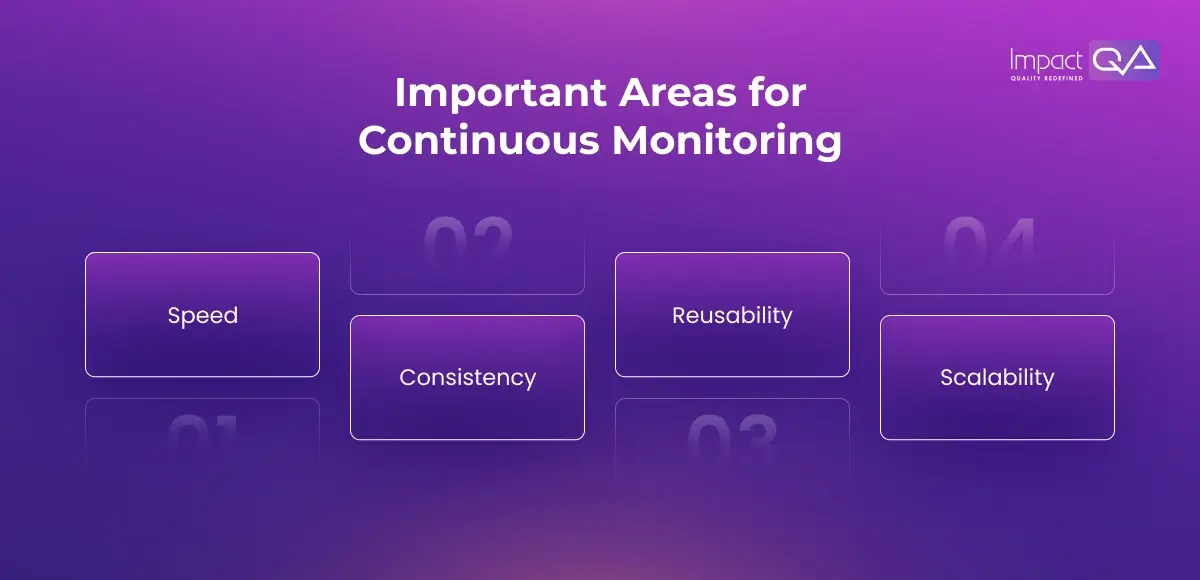
- Speed: Tests can be executed at any time, making the testing process faster and more efficient.
- Consistency: Automated tests eliminate human error to ensure that tests are executed consistently each time.
- Reusability: Once created, test scripts can be reused for various projects, saving both time and resources.
- Scalability: Automation allows for tests to be scaled across different environments without additional overhead.
Popular automation tools such as Selenium and JUnit enable testers to simulate user interactions, validate functionality, and verify that new software versions do not introduce regressions.
What is Hyperautomation?
Hyperautomation augments beyond the limits of traditional automation by funneling smart technologies like AI, machine learning, robotic process automation, and business process management. It aims to automate not just testing but the entire software development process, including everything from code generation to deployment and monitoring. Hyperautomation leverages intelligent technologies to manage business processes across all stages, automating end-to-end workflows with minimum human intervention.
Unlike traditional automation, which focuses on specific tasks, hyperautomation integrates AI-driven decision-making and automates complex processes within the development pipeline. This leads to improved efficiency and smarter workflows.

The benefits of hyperautomation include:
- End-to-End Automation: Hyperautomation integrates the entire software development lifecycle, from planning to deployment.
- AI-Driven Decisions: Machine learning and AI allow for more intelligent decision-making while reducing reliance on human input.
- Adaptability: Hyperautomation can automatically adjust to changes in the development environment, making it highly flexible.
- Reduced Human Involvement: RPA and AI reduce the need for human oversight, making the process more autonomous.
Hyperautomation tools work synergistically to create an integrated, seamless process that can adapt to dynamic business needs.
Key Differences Between Hyperautomation and Automation Testing
Sr. No. |
Aspect |
Automation Testing |
Hyperautomation |
| 1. | Scope | Focuses solely on automating testing tasks. | Automates the entire development lifecycle. |
| 2. | Technology | Primarily uses automation tools (e.g., Selenium, JUnit). | Combines AI, machine learning, RPA, and BPM tools. |
| 3. | Focus | Automates repetitive, predefined testing tasks. | Automates entire workflows and processes across development. |
| 4. | Intelligence | Limited to rule-based automation. | AI-powered with decision-making capabilities. |
| 5. | Human Involvement | Requires human intervention for test creation and monitoring. | Minimal human involvement; oversight is largely strategic. |
| 6. | Flexibility | Less flexible, mainly suitable for defined tasks. | Highly flexible, adapts to changes in real-time. |
| 7. | Implementation Time | Faster setup due to fewer components. | Longer implementation due to the integration of multiple technologies. |
| 8. | Cost | Lower cost in terms of initial investment. | Higher cost due to complex technology stack. |
| 9. | Efficiency | Speeds up testing processes, ensuring quicker feedback. | Increases efficiency across the entire development cycle. |
The Role of Hyperautomation vs Automation Testing in Software Development
While both approaches share a common goal of improving efficiency, their scope and application differ significantly. Automation testing remains crucial for agile environments, particularly in continuous integration and delivery (CI/CD) setups. By automating repetitive tasks, it allows testers to focus on more complex scenarios, speeding up the process without compromising quality. However, the approach is constrained by its reliance on human involvement for test case creation and its inability to handle intricate, decision-based tasks.
In contrast, hyperautomation integrates AI and RPA, pushing the boundaries of what can be automated. It streamlines the entire development lifecycle, including tasks that were traditionally outside the scope of automation testing. With hyperautomation, software teams benefit from proactive analytics, predictive capabilities, and AI-driven decisions that enhance testing processes and overall development efficiency.
Automation Testing in Agile Environments
In agile environments, where rapid development and iterative cycles are the foundation, automation testing becomes indispensable. Agile methodologies prioritize speed and adaptability, often requiring frequent iterations, updates, and releases. Without an efficient system for testing, maintaining quality in these fast-paced cycles would be nearly impossible. Automation testing helps address this challenge by enabling continuous integration and delivery (CI/CD). Thus, ensuring that the quality of software is consistently checked at every stage of development.
Automated testing serves as the backbone for routine testing tasks like regression testing, load testing, and performance testing. For projects that evolve quickly, automation ensures that changes made in one part of the application don’t inadvertently disrupt other sections of the software. It also allows for rapid feedback, as tests can be executed as soon as code is updated, thus identifying bugs or issues early in the cycle.
However, while automation testing significantly improves speed and consistency, it does have its limitations. It primarily focuses on executing predefined test scripts and may struggle with more complex, dynamic testing scenarios. It’s also important to note that automation testing still relies on humans to design the tests, write the scripts, and manage any exceptions. Therefore, it is susceptible to errors, especially if the scripts are not updated regularly to align with new features or updates. Furthermore, testing scenarios involving intricate user behavior or complex decision-making may be outside the capabilities of automated tools. Despite these drawbacks, automation testing remains a critical approach to ensuring quality in agile environments, especially for teams looking to accelerate their development cycles without compromising on reliability.
How Hyperautomation is Shaping the Future of Software Development and Testing
Hyperautomation represents a significant leap forward in the automation space, extending far beyond the boundaries of traditional automation testing. While automation testing is crucial for executing repetitive tasks, hyperautomation integrates multiple intelligent technologies to manage and optimize the entire software development lifecycle. This approach fundamentally differs from the typical approach since it does not only automate a single task or function but whole workflows-from code development through testing, all the way to its deployment and monitoring. Hence, by the use of AI, machine learning, and robotic process automation, hyperautomation creates a highly autonomous environment that is capable of adjusting, learning, and evolving thanks to real-time data insights.
One of the most attractive aspects of hyperautomation is its ability to automate complex, decision-based processes that go beyond the scope of traditional automation tools. AI-driven decision-making allows the system to evaluate scenarios, predict outcomes, and optimize workflows without requiring human intervention. This level of intelligence enables hyperautomation to be incredibly adaptive and capable of adjusting to changing conditions in a way that manual or traditional automated processes cannot.
Furthermore, hyperautomation brings significant benefits to the testing process. It can analyze large volumes of data to identify anomalies, track defects, and generate reports instantaneously. By utilizing machine learning algorithms, hyperautomation can even predict future issues and offer solutions before they impact the development process. This proactive approach reduces downtime, mitigates risks, and increases the overall quality of the product.
Despite its many advantages, hyperautomation is not without its challenges. The integration of AI, RPA, and machine learning technologies into an organization’s existing infrastructure requires careful planning and significant investment. The complexity of these systems can lead to longer implementation times and a steeper learning curve for teams who need to master these sophisticated tools. Additionally, hyperautomation tools must be meticulously calibrated to the unique needs of each organization, which can further complicate the integration process.
However, the potential for hyperautomation to transform the development and testing process is undeniable. As businesses continue to push for faster development cycles and higher quality, hyperautomation will play an increasingly central role in achieving these goals. By reducing human involvement in routine tasks and incorporating intelligent decision-making, hyperautomation will allow organizations to focus more on strategy and innovation, rather than on the minutiae of day-to-day operations. The future of software development and testing will likely see an even greater shift towards hyperautomation as organizations seek to stay ahead in a world that demands agility, speed, and high-quality outcomes.
Discover the power of automation and hyperautomation in optimizing your development lifecycle.
Conclusion
Both hyperautomation and automation testing will become one of the most important factors shaping the future of efficiency in testing and development. Automation testing will therefore provide support in the ever-quickening pace of modern environments, while hyperautomation will take development strategies and processes to a new level. Through the integration of the two methodologies mentioned, organizations will remain on top of their increasingly competitive market while releasing software in a quicker and more trustworthy manner.
For organizations seeking to make the most of these advancements, companies like ImpactQA provide tailored automation and hyperautomation solutions that meet the highest quality standards, ensuring success across the development lifecycle. Whether focusing on automation testing or exploring the capabilities of hyperautomation, businesses can rely on ImpactQA’s expertise to achieve precision, efficiency, and innovation in their software processes.
Share this post


Related Posts
Our Case Studies