Enabling Continuous Testing and Delivery in a Hybrid ERP (Oracle EBS and Dynamics 365) on FlexDeploy & Azure DevOps

Quick Summary:
Enterprises striving for faster release cycles often face an invisible barrier – the disconnect between development and quality assurance. Disjointed toolsets, fragmented reporting, and manual testing dependencies slow down progress and skew visibility across teams. By integrating tools like FlexDeploy and Azure DevOps (ADO), organizations can transform these silos into a unified, continuous delivery ecosystem. This blog explores how ImpactQA helps enterprises build connected Dev-QA environments that drive collaboration, traceability, and speed – supported by a real-world example from a North American Manufacturing Leader.
Table of Contents:
- The Growing Divide Between Dev and QA
- Pre-Integration Challenges in Enterprise QA Workflows
- Building an Integrated Dev-QA Ecosystem
- Quantifiable Business Impact and Technical Advantages
- Sustaining Scalability, Maintainability, and Future Readiness
- Conclusion
The Growing Divide Between Dev and QA
Modern enterprises, especially those running hybrid ERP and CRM ecosystems like Oracle E-Business Suite and Microsoft Dynamics 365, often face a recurring dilemma – their Dev and QA teams work in isolation. Developers plan and track work in platforms such as Azure DevOps, while QA teams execute and monitor testing in separate systems like qTest. The absence of synchronization results in limited traceability and delayed feedback, turning every release into a coordination challenge rather than a strategic rollout.
In organizations with complex supply chains or manufacturing systems, this disconnect magnifies risk. Each new feature, patch, or quarterly update demands careful coordination between developers, testers, and release managers. Manual processes, duplicate data entry, and person-dependent tasks slow progress. When QA lacks visibility into development backlogs or defect pipelines, testing becomes reactive instead of proactive.
To address this, global businesses are turning to integration-driven quality engineering, linking tools like Azure DevOps and FlexDeploy into one connected environment. This unified ecosystem aligns user stories with test cases and automates result synchronization. It further ensures that every change is tracked from requirement to deployment, supporting a culture of continuous testing across teams.
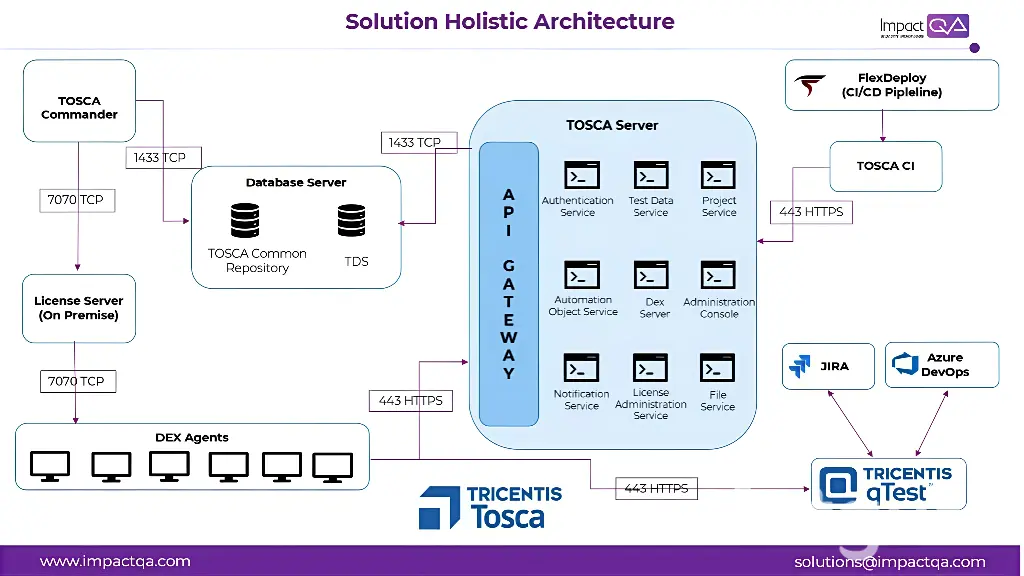
This visual illustrates the integration flow between tools, highlighting the continuous feedback loop that connects Dev and QA teams.
A notable industry case study comes from a North American Manufacturing Leader who successfully connected Jira, FlexDeploy, ADO, and qTest using Tricentis Integration Hub. This move not only reduced their QA planning effort by 40% but also achieved complete requirements-to-test traceability across both Oracle and Dynamics systems. Such examples prove that aligning Dev and QA is a catalyst for sustainable digital agility.
ImpactQA builds connected QA ecosystems that unify Jira, Azure DevOps, and qTest for seamless delivery.
Pre-Integration Challenges in Enterprise QA Workflows
Before integration, many organizations operate within fragmented systems that hinder collaboration and data consistency. The result is an overreliance on manual effort, inconsistent reporting, and a skewed understanding of quality metrics.
Common Pre-Integration Challenges:
Disjointed Tools: Development often relies on Jira or ADO, while QA teams work independently in qTest. Without integration, requirements and test cases remain isolated.
- Manual Synchronization: Teams spend hours duplicating stories, defects, and reports across tools, leading to inaccuracies and delays.
- Lack of End-to-End Traceability: Without a connected chain between requirements, test cases, and defects, compliance and audit tracking become complex.
- Delayed Feedback Loops: Developers lack real-time insight into QA progress or failed test scenarios.
- Reporting Gaps: Leadership teams have no unified dashboard to evaluate quality and readiness across all platforms.
Typical Pre-Automation Metrics:
Parameter |
Before Integration |
| Test Execution Effort | ~40–50 hours per week |
| Reporting Accuracy | Inconsistent |
| Requirement Coverage | 60–70% (manual traceability) |
| Feedback Loop Delay | 2-3 days |
| Regression Readiness | Manual and partial |
Building an Integrated Dev-QA Ecosystem
The key to resolving these inefficiencies lies in establishing a single, unified testing ecosystem that interlinks all core tools across development, QA, and deployment.
A strategic integration between tools like Jira, Azure DevOps, Tosca, FlexDeploy, and qTest can deliver end-to-end visibility, automation-driven accuracy, and continuous test feedback. Here’s how each component plays a crucial role:
Integration Framework Overview
Artifact |
Connected Tools |
Sync Direction |
Purpose |
| Requirements (Epics, Features, PBIs) | Jira / ADO → qTest | One-way | Syncs product backlog items directly with test management |
| Defects | Jira / ADO ↔ qTest | Bi-Directional | Enables real-time bug reporting and status updates |
| Test Cases | qTest → Jira / ADO | One-way | Provides QA ownership with transparency for developers |
| Pipelines | FlexDeploy / ADO → qTest | Result Sync | Publishes execution results directly into QA dashboards |
By integrating Tosca within this ecosystem, test execution becomes autonomous. Tosca’s model-based automation eliminates script maintenance challenges and executes regression suites through FlexDeploy or ADO pipelines. In ERP environments, such as Oracle EBS, this allows nightly or on-demand regression cycles without manual intervention.
For instance, the case study of the North American Manufacturing Leader mentioned above combined the use of Jira, ADO, and Tosca, enabling automated validation across Oracle EBS and Microsoft Dynamics 365 modules, significantly reducing cycle times and manual errors.
Quantifiable Business Impact and Technical Advantages
When executed strategically, Dev-QA integration delivers measurable business and operational improvements. It not only simplifies workflows but also embeds quality into every sprint cycle.
Key Measurable Outcomes:
- 40% Reduction in QA Planning Effort: Automation of test case association and traceability reduces planning overhead.
- 100% Requirements-to-Test Coverage: Ensures no story proceeds without corresponding validation.
- 3x Faster Feedback Loops: Real-time defect reporting between ADO/Jira and qTest shortens turnaround time.
- Improved Governance: Unified dashboards offer visibility across sprint progress, defect age, and quality trends.
- Regulatory Readiness: Compliance traceability supports internal audits and external quality checks.
Technical Advantages:
- Automation-Centric Testing: With Tosca’s model-based framework, test creation and maintenance become faster, cutting dependency on scripting expertise and strengthening continuous testing pipelines.
- Rule-Based Synchronization: Smart sync rules automate the linking of QA artifacts, ensuring consistency across platforms.
- Centralized Reporting: Insights consolidated in qTest dashboards improve executive decision-making.
- Continuous Feedback Cycle: Integration with FlexDeploy pipelines ensures that every deployment triggers corresponding test validations.
Such a unified model redefines the QA process, turning it from a downstream activity into a continuous enabler of delivery confidence.
Sustaining Scalability, Maintainability, and Future Readiness
The long-term success of any integration framework depends on its ability to scale and adapt. As enterprise ecosystems expand, new modules, APIs, and automation layers are introduced. A well-architected integration between all the tools is inherently future-ready.
Sustainability and Maintainability Factors:
- Reusability: Tosca’s reusable automation modules minimize duplication and simplify regression suite expansion.
- Adaptability: API-driven connectors can easily integrate with new platforms or upcoming tool versions.
- Maintainability: Automated sync reduces human dependency and ensures consistent artifact updates.
- Analytics-Driven Decision-Making: Centralized data allows predictive analysis of quality trends.
By embedding scalability into Dev-QA alignment, organizations avoid rework and reconfiguration during upgrades or platform transitions. This positions QA not as a supporting function but as a driver of modernization.
ImpactQA designs integration-led QA frameworks that evolve with your enterprise ecosystem.
Conclusion
As enterprises accelerate their digital transformation journeys, the line between development and quality is blurring, and rightly so. The future of software delivery is defined by smarter engineering, where quality is embedded into every commit, every test, and every deployment. This shift highlights the need for stronger integration across tools and teams.
Integrating tools is the foundation of a culture where collaboration replaces silos, insights replace guesswork, and automation drives continuous confidence. In this ecosystem, QA is no longer a gatekeeper at the end of the cycle but an active enabler of innovation and speed.
At ImpactQA, we believe the path to continuous quality delivery lies in synchronization, bringing together people, platforms, and processes into a single rhythm of excellence. By aligning development intent with testing intelligence, organizations can achieve not just faster releases, but fearless ones – confident, compliant, and ready for what’s next.
Share this post


Related Posts
Our Case Studies