The Strategic Importance of Digital Assurance in Modern Retail IT Ecosystems

Quick Summary:
Retail is undergoing rapid digital transformation. From AI-powered personalization to omnichannel experiences, retail IT systems are becoming more complex. This blog explains why digital assurance in the retail industry is crucial to building stable, scalable, and secure platforms. It examines key challenges, technical strategies, testing methodologies, and how specialized QA partners like ImpactQA drive measurable outcomes for modern retail brands.
Table of Contents:
- Introduction
- What Makes Retail IT So Demanding?
- Why Digital Assurance in Retail Cannot Be Ignored
- Key Testing Domains in Retail IT
- Challenges Slowing Down Assurance
- Tools, Automation, and Intelligence in Retail QA
- How ImpactQA Supports Retail Growth
Retail continues to evolve on two fronts. On one hand, digital commerce is expanding rapidly, projected to reach $6.8 trillion by 2028. On the other hand, the majority of retail activity will still take place offline, with in-store sales accounting for over $21 trillion. This duality increases pressure on brands to build unified IT ecosystems that deliver a consistent experience across both channels. This dual growth creates a pressing need for unified IT ecosystems that support both digital and physical retail operations.
Modern retail systems operate across mobile apps, websites, backend tools, and APIs – all working together. A delay in syncing inventory, a payment failure, or a broken mobile feature can disrupt the customer’s journey. Even small errors can lead to abandoned carts and reduced revenue. This is where digital assurance plays a vital role. It ensures systems work seamlessly and securely under varying traffic conditions. More than just finding bugs, it’s about validating performance, reliability, and user experience end to end.
Work with ImpactQA to automate QA across your pipeline and reduce release friction.
What Makes Retail IT So Demanding?
Retail operations today are built on a web of interconnected digital and physical systems. Behind the storefront lies a network of platforms that must work in sync to support real-time demand, inventory accuracy, and seamless customer journeys. Any disconnect can ripple across touchpoints, impacting both business performance and customer satisfaction.
Retail systems now span:
- Omnichannel purchase paths (web, app, kiosk)
- Inventory syncing and order fulfillment
- Dynamic pricing and promotions
- CRM and marketing automation tools
- Third-party APIs like payment gateways and logistics
Each of these modules connects across cloud-native platforms and distributed databases. Without integrated testing, even a small failure can disrupt the entire purchase flow.
Common sources of complexity include:
- Seasonal traffic spikes that demand load testing
- Frequent releases from agile teams
- Diverse integrations with external tools
- High customer expectations for speed and accuracy
Retailers also need to deal with:
| System | Testing Concern |
|---|---|
| Payment Gateway | Transaction failures, PCI DSS validation |
| Inventory System | Real-time sync, stock visibility |
| Mobile Apps | Device coverage, push notifications |
| Order Management | Workflow automation, fraud detection |
Digital assurance helps stitch these parts into a working whole. It validates that every system communicates and performs as expected.
Why Digital Assurance in Retail Cannot Be Ignored
Shoppers expect quick, reliable service. Even a one-second delay in load time can reduce conversions by 7%. Digital assurance validates whether systems can handle such expectations consistently.
It helps by:
- Testing across user journeys like browsing, checkout, and delivery tracking
- Running stress tests to simulate traffic surges
- Validating APIs that connect loyalty programs, ERPs, and payment systems
- Securing customer data in real-time across every transaction
Retailers benefit from:
- Faster release cycles through automated regression testing
- Reduced downtime during high-traffic sales events
- Fewer production defects through continuous integration testing
Without assurance, risks include:
- Broken checkout flows
- Incorrect pricing or promotions
- Security vulnerabilities in APIs
- Downtime during key sales events
Key Testing Domains in Retail IT
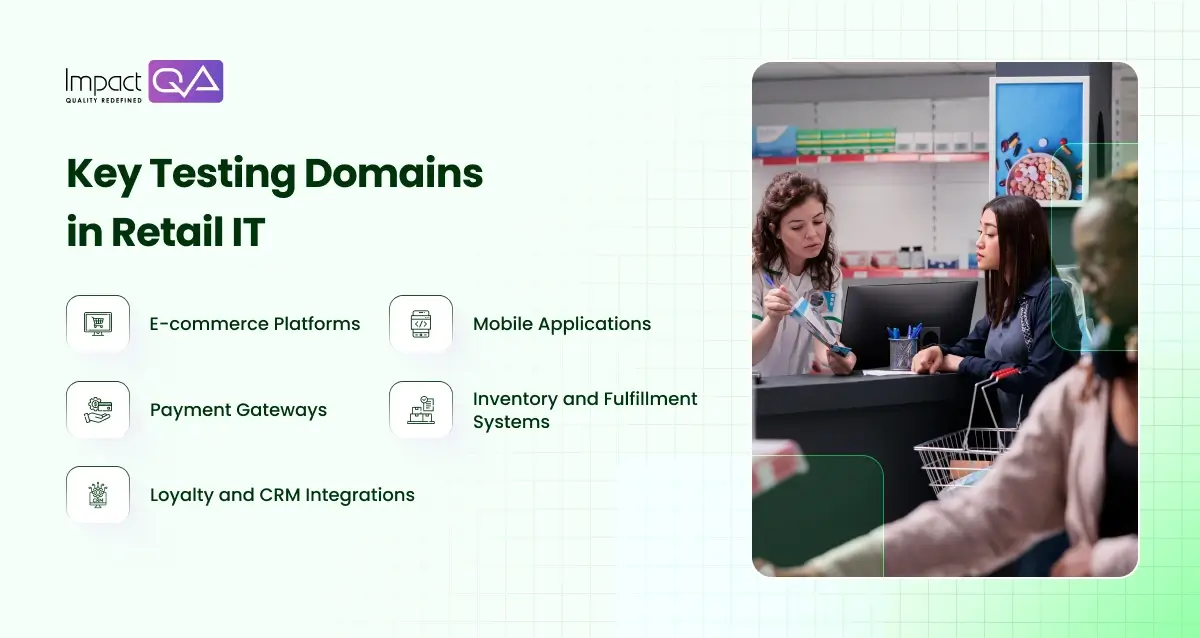
To maintain reliability, testing must extend across several high-impact domains. Retail IT environments are shaped by high user expectations and rapid deployment cycles. Without coverage across all functional areas, even small issues can break the user’s journey or delay order fulfillment.
Each domain carries its own set of dependencies, user expectations, and integration points. Ensuring that these domains work individually and together is essential for seamless operations.
1. E-commerce Platforms
- Validate product listings, filters, cart logic, and promotions
- Ensure consistent checkout flows across browsers
2. Mobile Applications
- Test across real devices, screen sizes, and OS versions
- Cover biometric login, mobile payments, and push alerts
3. Payment Gateways
- Test encryption, transaction workflows, and 3DS authentication
- Simulate declined, delayed, and successful transactions
4. Inventory and Fulfillment Systems
- Check stock updates post-purchase
- Validate integration with warehouse and shipping partners
5. Loyalty and CRM Integrations
- Validate points calculation and redemption workflows
- Ensure data syncs across email tools, SMS, and promotions
- Testing should use real test data, including SKUs, user segments, pricing tiers, and offers. This brings retail QA closer to production-like accuracy.
ImpactQA can help you run predictive load tests and fix weak points before customers notice.
Challenges Slowing Down Assurance
Despite adopting agile and digital-first approaches, many retailers struggle to align their QA efforts with rapid deployments. Gaps in coordination, infrastructure, or tooling often prevent them from meeting reliability benchmarks.
Retail teams often face common hurdles:
- Fragmented QA efforts: Test cases are siloed across frontend, backend, and mobile.
- Lack of test data: Without production-like data, tests miss edge cases.
- Manual dependencies: Human-driven tests delay feedback and limit coverage.
- Limited observability: Failures in production go unnoticed until customers report them.
Ways to address these challenges:
- Create shared test repositories and reusable test modules
- Use synthetic and masked production data for deeper coverage
- Integrate logs and error tracking into QA reports
- Shift testing left and automated feedback during early sprints
A central QA strategy across teams improves collaboration and speeds up releases. It creates shared visibility across development, QA, and operations. Teams are able to act faster, test deeper, and fix defects earlier – without waiting for siloed handovers or fragmented feedback loops.
Tools, Automation, and Intelligence in Retail QA
Digital assurance depends on toolchains that are scalable and intelligent. As digital storefronts evolve and IT stacks diversify, having the right tools becomes critical for aligning QA efforts with development goals. These tools are not just for running scripts – they bring precision, speed, and consistency into the testing process.
Common tools by purpose:
| Purpose | Tool |
|---|---|
| UI Testing | Selenium, Cypress |
| Mobile Testing | Appium, BrowserStack |
| API Testing | Postman, REST Assured |
| Load Testing | JMeter, Gatling |
| CI/CD Orchestration | Jenkins, GitHub Actions |
| Security Scanning | OWASP ZAP, Burp Suite |
Advanced techniques include:
- AI-led test prioritization: Focus on high-risk modules
- Self-healing scripts: Reduce maintenance when UI changes
- Visual testing: Detect layout or branding mismatches
- Voice and chatbot validation: Test speech-to-text and NLP engines
Automation improves accuracy while freeing testers from repetitive tasks. When integrated with release pipelines, it shortens cycle times and increases test confidence.
How ImpactQA Supports Retail Growth
Retail success depends on more than new features. It relies on the consistent quality of every digital touchpoint. ImpactQA supports this with QA frameworks designed for high-volume, integration-rich environments.
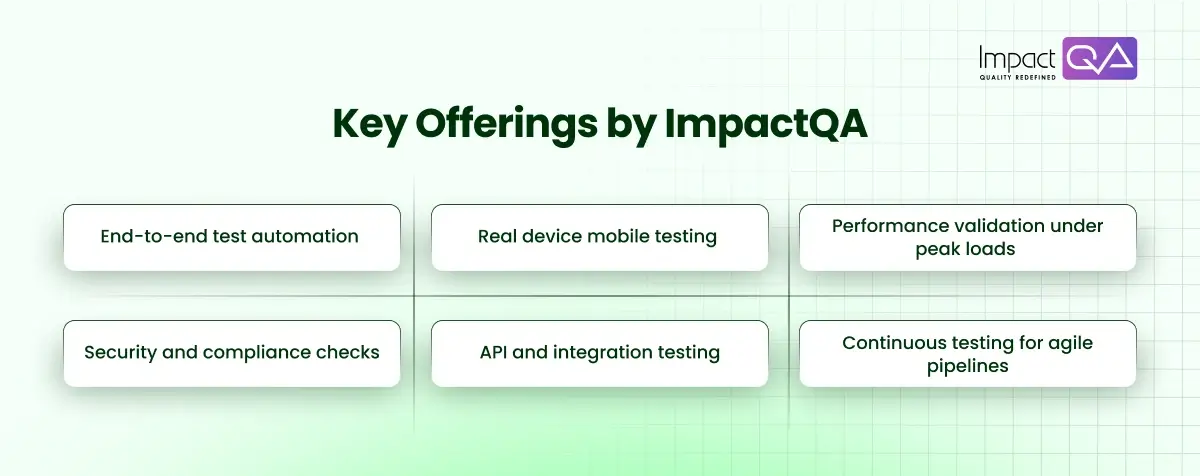
Key offerings include:
- End-to-end test automation
- Real device mobile testing
- Performance validation under peak loads
- Security and compliance checks
- API and integration testing
- Continuous testing for agile pipelines
ImpactQA helps retail brands deliver secure, stable, and scalable systems across geographies. Whether you’re launching a new platform or scaling during the festive season, our QA services ensure speed doesn’t compromise quality.
Our experience spans B2C, B2B, and C2C commerce models, offering usability testing, performance validation, cross-device compatibility checks, and integration support across platforms like Magento, Shopify, and WooCommerce. We also apply quality engineering principles, accelerators, and domain-specific test assets to improve turnaround times and reduce rework.
The company’s flexible engagement models and skilled professionals have helped global e-commerce firms overcome challenges like downtime, confusing interfaces, and security threats. Backed by 150+ certified QA professionals and more than 40 successful retail projects, ImpactQA continues to be a trusted partner for digital assurance in retail.
Share this post


Related Posts
Our Case Studies