Quick Summary:
Automation testing is moving from script execution toward AI-assisted and increasingly autonomous quality engineering. This guide examines five automation testing tools relevant to 2027, covering open-source frameworks, developer-focused tools, mobile automation, enterprise platforms, and AI-native testing. The right choice depends on application architecture, team skills, test coverage, integration requirements, and how much intelligence the organization expects its automation platform to provide.
Table of Contents:
- Introduction
- What Is Changing in Test Automation?
- 5 Best Automation Testing Tools for 2027
- How to Choose the Right Test Automation Tool
- What to Expect From Automation Testing Tools in 2027
- Final Say
- FAQs
Automation testing has solved one problem for software teams for years: repeatability. But as applications become more distributed and software releases accelerate, a second problem has become harder to ignore: maintaining the automation itself.
A test suite can only provide value when it remains reliable as the application, browsers, devices, APIs, and development pipeline change.
That is why the automation testing market is increasingly moving toward AI-assisted capabilities. Gartner’s 2026 research describes AI-augmented software testing tools as platforms that can generate and maintain tests, optimize and prioritize suites, analyze results, and increasingly operate with less human intervention. Gartner is now explicitly tracking the transition toward agentic software quality assurance platforms.
Forrester’s 2026 research points in a similar direction. After speaking with 37 enterprise customers, it found that organizations using autonomous testing platforms reported automating roughly 51%–60% of their tests on average, compared with the historical automation plateau of around 25%.
Against that backdrop, the most relevant automated software testing tools for 2027 are increasingly being evaluated on more than browser support or scripting languages. AI-assisted authoring, self-healing, natural-language interaction, test intelligence, cross-platform execution, and integration with modern delivery pipelines increasingly matter as well.
ImpactQA connects intelligent automation with broader Quality Engineering to support faster, more consistent testing.
What Is Changing in Test Automation?
The traditional model is familiar:
Write the script → execute the test → investigate failures → repair the script → repeat.
Modern automation is moving toward:
Define the test intent → generate or adapt the test → execute → analyze → prioritize → maintain.
That does not make conventional frameworks obsolete. Selenium, Playwright, Cypress, and Appium remain important because they provide the engineering control required for many automation programs.
Enterprise teams now have a wide consider, from established frameworks to AI-assisted platforms that can support authoring, maintenance and analysis. Gartner’s current criteria for AI-augmented testing include natural-language interfaces, generative AI for test development, self-healing, integrations, and native UI, API, and visual testing.
5 Best Automation Testing Tools for 2027
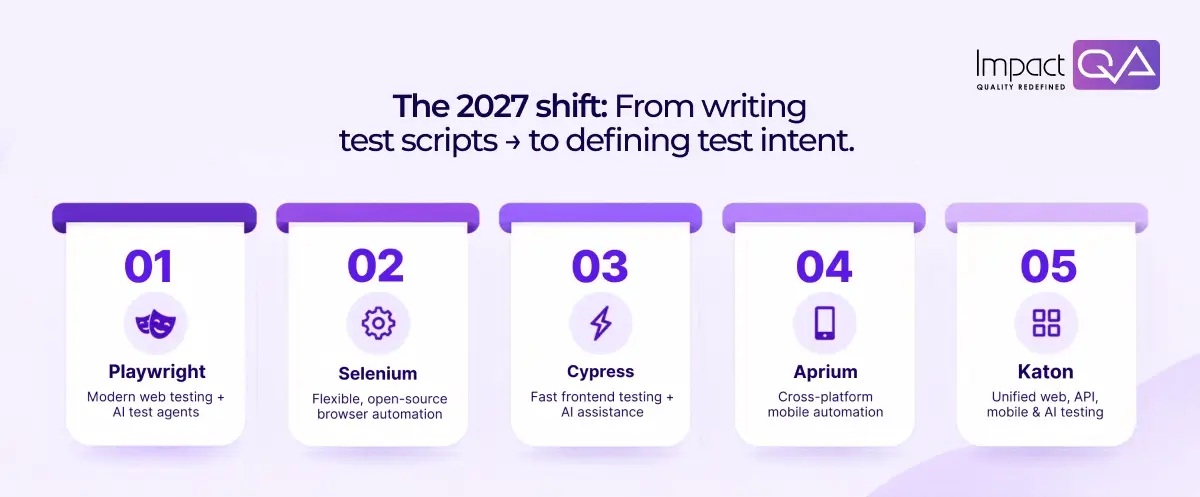
1. Playwright — For Modern Web Application Testing
Playwright has become a major option for teams building automated end-to-end tests for modern web applications.
It supports Chromium, Firefox, and WebKit and provides capabilities for browser automation, parallel execution, tracing, screenshots, API testing, and CI workflows.
What makes Playwright particularly relevant heading into 2027 is its move into AI-powered testing. Its recent releases introduced Playwright Test Agents, including planner, generator, and healer agents designed to help explore an application, create test plans, generate tests, and repair failing tests.
Best suited for: Modern web applications, engineering-led QA teams, cross-browser testing, and teams that want strong programmatic control with emerging AI capabilities.
2. Selenium — For Flexible, Open-Source Web Automation
Selenium remains a foundational choice for web automation because of its flexibility, large ecosystem, and support for multiple languages and browsers.
Selenium WebDriver provides browser automation through standard interfaces, while Selenium Grid enables distributed execution. The current Selenium ecosystem also includes WebDriver BiDi capabilities for bidirectional browser communication.
Its main advantage is control. Teams can build their own frameworks, integrate Selenium with existing development infrastructure, and customize the automation layer around specific application requirements.
Best suited for: Enterprise web applications, custom automation frameworks, open-source environments, and teams with strong automation engineering capabilities.
3. Cypress — For Developer-Centric Web Testing
Cypress is particularly suited to modern frontend development, where developers and QA engineers need fast feedback while building web applications.
Its architecture runs tests directly in the browser and provides interactive debugging, component testing, end-to-end testing, and cloud-based test analytics.
Cypress has also moved quickly into AI-assisted testing. Its current platform supports natural-language test creation, AI-assisted assertions, self-healing capabilities, and AI-agent interaction with Cypress sessions. Its September 2026 releases include Cypress 16.1 and additional AI-oriented capabilities.
Best suited for: JavaScript and TypeScript applications, frontend-heavy teams, component testing, rapid debugging, and AI-assisted test development.
4. Appium — For Mobile Application Automation
Mobile testing requires a different automation layer because applications must be validated across operating systems, device configurations, native interfaces, and hybrid applications.
Appium remains an important open-source option for mobile automation. Its current documentation supports Android and iOS-oriented workflows through its driver and client ecosystem, while Appium 3 introduced a leaner architecture, updated platform requirements, and security-related improvements.
Appium can also sit alongside other test automation tools and device-cloud platforms, making it useful within larger mobile quality engineering programs.
Best suited for: Native, hybrid, and mobile web applications requiring programmatic Android and iOS automation.
5. Katalon True Platform — For Unified, AI-Assisted Testing
Katalon has expanded from a conventional test automation product into a broader quality platform.
Its current True Platform combines test automation, test management, execution, and production insights. Katalon Studio supports web, API, mobile, and desktop testing through no-code, low-code, and full-code approaches. Katalon AI can generate test cases from requirements, help heal locators, and summarize release readiness.
This makes Katalon relevant for organizations that want one platform spanning several testing activities rather than assembling multiple independent tools.
Best suited for: Cross-platform testing, mixed-skill QA teams, organizations seeking no-code/low-code options, and enterprises looking for a unified quality platform.
Apart from these well-known automation tools, here are two more cutting edge tools:
# Tricentis Tosca — For Enterprise End-to-End Automation
Enterprise applications introduce challenges that simple browser automation cannot always address. SAP, Oracle, packaged applications, APIs, and complex business processes may all need to be validated within the same release cycle.
Tricentis Tosca is designed around model-based enterprise test automation and supports end-to-end testing across complex application environments.
Its 2026 product direction is increasingly agentic. Tricentis introduced agentic test automation for Tosca, using purpose-built agents to generate tests, work across enterprise technologies including SAP and web applications, and adapt existing modules for reuse.
Best suited for: Large enterprises, packaged applications, SAP environments, complex business processes, and organizations moving toward governed AI-assisted quality engineering.
# Falcon — For AI-Native, No-Code Automation
Falcon represents a different direction: instead of using AI primarily to assist script creation, it makes test intent the starting point.
Users describe what they want to test in plain English. Falcon’s AI agent interprets the screen, determines the next action, executes the workflow, and provides execution evidence and confidence information.
Its current capabilities include no-code automation, self-healing, confidence scoring, visual testing, codeless REST API automation, real-device Android testing, chatbot QA, cloud execution, and CI/CD integrations.
The platform therefore targets a problem that traditional automation frameworks do not fully solve: reducing the amount of scripting and maintenance required to scale automation.
Best suited for: Teams comparing the best AI automation testing tools for no-code automation, self-healing, API and UI testing, chatbot validation, and broader agentic QA.
Automation Testing Tools: At a Glance
Tool |
Primary Strength |
AI/Agentic Direction |
Best Fit |
| Playwright | Web automation | Test agents | Modern web applications |
| Selenium | Flexible browser automation | Extensible ecosystem | Enterprise web testing |
| Cypress | Frontend testing | AI-assisted authoring and debugging | JavaScript/TypeScript teams |
| Appium | Mobile automation | Evolving ecosystem | Android/iOS testing |
| Katalon | Unified testing | AI-assisted lifecycle | Cross-platform QA |
| Tricentis Tosca | Enterprise automation | Agentic Test Automation | SAP and complex enterprises |
| Falcon | AI-native no-code testing | Autonomous execution and self-healing | AI-led, scriptless automation |
There is no universal winner among these testing and automation tools. A framework that fits a developer-centric web application may be unsuitable for a heavily packaged enterprise environment, while a no-code platform may solve maintenance challenges that a conventional framework leaves to engineering teams.
How to Choose the Right Test Automation Tool
Tool selection should begin with the application landscape. Here are some things to consider while choosing the right test automation tools:
1. Consider Application Coverage
Determine whether the automation program is primarily for web, mobile, API, desktop, packaged enterprise applications, or a combination.
2. Assess Team Skills
A code-first framework may work well for teams with strong programming expertise. No-code or low-code platforms can make broader participation possible.
3. Measure Maintenance Requirements
Ask how much effort is currently spent repairing selectors, updating scripts, stabilizing flaky tests, and adapting automation after releases.
4. Examine CI/CD Integration
The tool should fit the existing software delivery environment. Jenkins, GitHub Actions, Jira, cloud execution, device labs, source control, and reporting integrations can influence how easily automation becomes part of the release process.
5. Evaluate AI Beyond Test Generation
AI test automation should not be judged solely on whether it can generate scripts. Gartner’s current market definition points toward broader capabilities including test maintenance, prioritization, analysis, self-healing, and autonomous execution.
6. Consider Governance
As AI takes a larger role in testing, organizations need visibility into what agents are doing, what data they use, how failures are interpreted, and when human review is required.
For organisations comparing tools alongside automation testing services, the same evaluation should extend to implementation expertise, framework governance and ongoing test maintenance.
When evaluating automation testing companies, look beyond the toolset itself. The stronger comparison considers implementation capability, domain expertise, integration support and the team’s approach to long-term automation governance.
What to Expect From Automation Testing Tools in 2027
The testing landscape is moving from automation toward autonomous quality engineering.
Forrester’s research describes the shift from continuous automation platforms toward autonomous testing platforms, while Gartner’s 2026 research similarly points toward increasingly autonomous AI agents within software testing.
Three changes are especially relevant.
First, test creation is becoming intent-driven. Natural-language interfaces allow users to describe requirements rather than manually construct every automation step.
Second, test maintenance is becoming adaptive. Self-healing and agentic approaches are designed to respond to application changes instead of simply reporting broken scripts.
Third, AI itself becomes part of the testing scope. Forrester’s September 2026 guidance emphasizes that AI-infused applications require continuous testing and evaluation for areas such as reliability, usefulness, and trustworthy behavior alongside conventional functional, performance, security, and integration testing.
The implication is significant: the automation tool of the future will not simply execute more tests. It will help teams determine which tests matter, how they should be executed, and what the results mean.
ImpactQA helps validate AI-enabled automation workflows across the software testing lifecycle.
Final Say
The automation testing market is entering a more intelligent phase.
Traditional frameworks remain important because they provide control, flexibility, and mature automation capabilities. At the same time, AI is changing how tests are created, maintained, prioritized, and analyzed.
For 2027, the meaningful distinction is therefore not simply between one automation framework and another. It is between automation that executes predefined instructions and automation that can increasingly understand intent, adapt to change, and assist with quality decisions.
The right tool depends on the application, organization, and testing strategy. What matters is selecting technology that can expand coverage without allowing automation itself to become the next bottleneck in software delivery.
Share this post


Related Posts
Our Case Studies