Quick Summary:
Katalon’s State of Software Quality Report found that 68% of organizations say AI-driven development is creating testing bottlenecks, and traced most of that bottleneck to the handoff structure between development and QA. This piece walks through 10 specific signs that a DevOps testing strategy has fallen behind the release cycle it’s supposed to support, and what each one usually points to underneath the surface.
Table of Contents:
- Introduction
- Why This Gap Is Showing Up Now
- 10 Signs Your DevOps Testing Strategy Is Falling Behind
- Final Say
- Frequently Asked Questions
Release cadence keeps compressing.
Testing has to keep pace with it. When validation starts lagging, the symptoms usually appear inside the pipeline first: slow regression runs, repeated flaky-test reruns, late performance checks, manual environment setup, and coverage metrics nobody trusts.
That is where DevOps test automation becomes useful. It keeps validation closer to development and helps teams maintain feedback as delivery speeds up.
The challenge sits deeper when the pipeline itself has grown harder to measure. Teams comparing DevOps testing companies or reviewing an existing setup need to look beyond automation volume and examine where time, confidence, and visibility are being lost.
This article presents 10 signs that provide that health check for DevOps teams. Keep reading to know more!
Why This Gap Is Showing Up Now
AI-assisted development is increasing software delivery volume, while QA teams have to maintain test suites, environments, data, and release controls. Greptile’s research recorded a 76% rise in developer output, alongside larger pull requests. More change enters the delivery process in less time.
Meanwhile, more than 55% of the organizations face challenges adopting AI-powered tools, while 60% struggle with secure, scalable test data.
That combination puts pressure on DevOps software testing. Test design, execution, data, environments, and maintenance all have to move with the release cycle.
ImpactQA maps testing bottlenecks and builds automation around actual release velocity.
10 Signs Your DevOps Testing Strategy Is Falling Behind
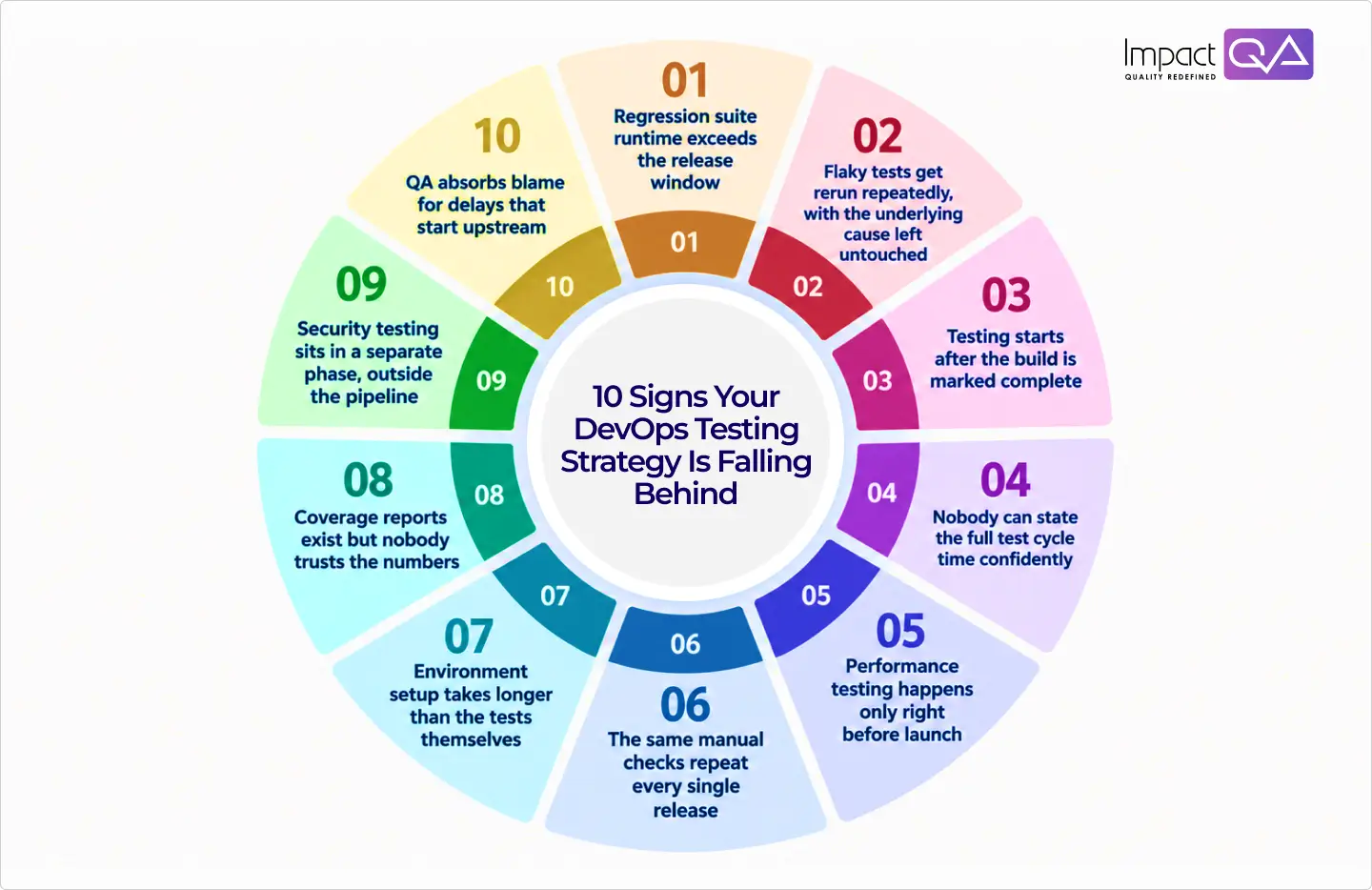
A DevOps testing strategy starts falling behind when validation takes longer than delivery, feedback arrives too late, or teams lose confidence in pipeline results.
These 10 signs cover regression, automation, performance, environments, coverage, security, and the handoffs connecting development with QA.
1. Your Regression Suite Takes Longer Than Your Release Cadence Allows
A team releasing several times a day cannot depend on a regression suite that takes six hours to finish.
Once runtime exceeds the release window, teams begin making trade-offs around validation. Tests get deferred, selected runs become the norm, and the value of the suite starts shrinking.
Look at total runtime, parallel execution, test distribution, and how much of the suite genuinely needs to run for each change.
2. Flaky Tests Get Rerun, Never Actually Fixed
A flaky test weakens the signal between a failure and a real defect.
The pattern is familiar. A test fails, someone reruns it, the pipeline turns green, and the root cause remains open. Over time, developers learn to treat failures as noise.
That makes flaky-test removal a release engineering issue as much as a QA task.
3. Testing Still Starts After the Build Is “Done”
Shift left testing in DevOps moves validation closer to development, beginning with early code changes and continuing through the delivery pipeline.
When QA enters only after merging, defects travel further before investigation. Rework grows, context switches increase, and the remaining release window gets tighter. ImpactQA’s article on shift left testing in DevSecOps explains how earlier validation changes the testing lifecycle.
4. Nobody Can Say How Long a Full Test Cycle Actually Takes
Ask for the complete devops automated testing cycle time.
A useful answer should account for execution, environment setup, test data, reruns, and reporting. When every team gives a different number, the pipeline lacks basic observability.
That makes improvement difficult because nobody can see which stage consumes the most time.
5. Performance Testing Happens Right Before Launch
DevOps performance testing works better when performance signals appear throughout the delivery cycle.
Lightweight checks can run earlier. Heavier load and stress scenarios can sit later in the pipeline. This creates earlier visibility into response time, throughput, database behaviour, and resource constraints.
That is the practical role of performance testing devops teams need as releases become more frequent. ImpactQA’s research piece performance testing trends redefining software quality in 2026 examines this shift toward continuous performance validation.
6. The Same Manual Checks Get Repeated by Hand Every Release
Automation testing in devops should progressively reduce repetitive validation work.
When the same checklist appears every release, examine the workflow itself. Stable, repeatable checks may be strong automation candidates. Scenarios requiring judgment may need to remain manual.
The useful measurement is simple: how often does the task repeat, how much time does it consume, and what risk does it cover?
7. Environment Setup Eats More Time Than the Tests Themselves
Test execution loses value when the environment takes longer to prepare than the tests.
Manual provisioning, configuration drift, test-data setup, and dependency checks can all create waiting time before a test starts. This makes environment engineering part of devops testing services rather than a separate infrastructure concern.
A mature pipeline automates provisioning, configuration, test data, dependencies, and teardown wherever the workflow is stable enough to support it.
8. Test Coverage Reports Exist, But Nobody Trusts the Numbers
Coverage metrics matter when teams understand what the percentage actually measures.
An 85% figure can still hide shallow assertions, duplicated checks, untested integrations, or business paths outside the measured scope.
Look beyond the percentage. Check which layers are covered, what remains outside the metric, and how the team uses the data to choose its next testing priorities.
9. Security Testing Is a Separate Phase, Not Part of the Pipeline
DevSecOps places security validation closer to the same CI/CD flow used for functional and performance testing.
SAST, DAST, dependency scanning, API security checks, and related controls can provide earlier feedback as changes move through development.
A separate security phase pushes that feedback toward the end of the release process, when fixes have less room to fit into the cycle.
10. QA Gets Blamed for Delays That Start Upstream
Katalon’s research found that 68% of organizations report AI-driven development creating testing bottlenecks. Katalon also identifies the handoff structure between development and QA as a major source of that friction.
That makes this sign worth examining closely.
A slow release can involve environment delays, unstable automation, test-data problems, build dependencies, or development handoffs. QA may be the final stage visible to everyone while the constraint sits earlier in the process.
Map the full path before changing team capacity.
ImpactQA integrates automated environment provisioning into CI/CD pipelines.
Final Say
A healthy DevOps testing strategy keeps validation aligned with release velocity. When regression, environments, automation, performance, or security checks fall behind, the pipeline starts creating delays of its own. The first step is measuring where that friction enters the delivery cycle.
Start with four numbers: regression runtime, flaky-test reruns, environment setup time, and the time between code completion and meaningful test feedback.
Those measures quickly show where the delivery process is slowing down. From there, teams can target the specific constraint instead of expanding the testing stack blindly.
AI-assisted development will continue increasing delivery speed. Testing has to evolve at the same pace.
Frequently Asked Questions (FAQs)
Share this post


Related Posts
Our Case Studies