Quick Summary:
AI in oil and gas has moved into production-grade deployment. This article covers real-world use cases across upstream, midstream, and downstream operations, backed by 2025–26 data from the IEA and McKinsey. It also explains why AI outputs depend on the ERP, CTRM, and maintenance systems that act on them, and what that means for validation.
Table of Contents:
- Introduction
- AI in Upstream: Exploration and Production
- AI in Midstream: Pipelines, Storage, and Emissions
- AI in Downstream: Refining and Trading
- Where AI Meets Oil and Gas Industry Software
- How ImpactQA Supports AI Programs in Oil and Gas
- Final Say
- FAQs
The oil and gas industry adopted AI…way earlier. The IEA notes that the industry has used it to optimize exploration, production, maintenance, and safety. Spending reflects that head start: Mordor Intelligence values the AI in oil and gas market at USD 4.28 billion in 2026 and projects it will reach USD 7.91 billion by 2031.
The interesting part is where the value shows up. Upstream captures most of the spend. Some of the clearest returns, however, sit in maintenance, emissions control, and refinery margins. This article maps AI solutions in the oil and gas industry across upstream, midstream, and downstream operations and explains how they connect to the enterprise software oil and gas companies already run.
ImpactQA tests SAP and connected oil and gas systems across critical business processes and integrations.
AI in Upstream: Exploration and Production
Upstream dominates AI investment. Mordor Intelligence attributes 61.05% of 2025 revenue to upstream, because exploration and production workflows are the most data-heavy.
1. Seismic Interpretation and Subsurface Modeling
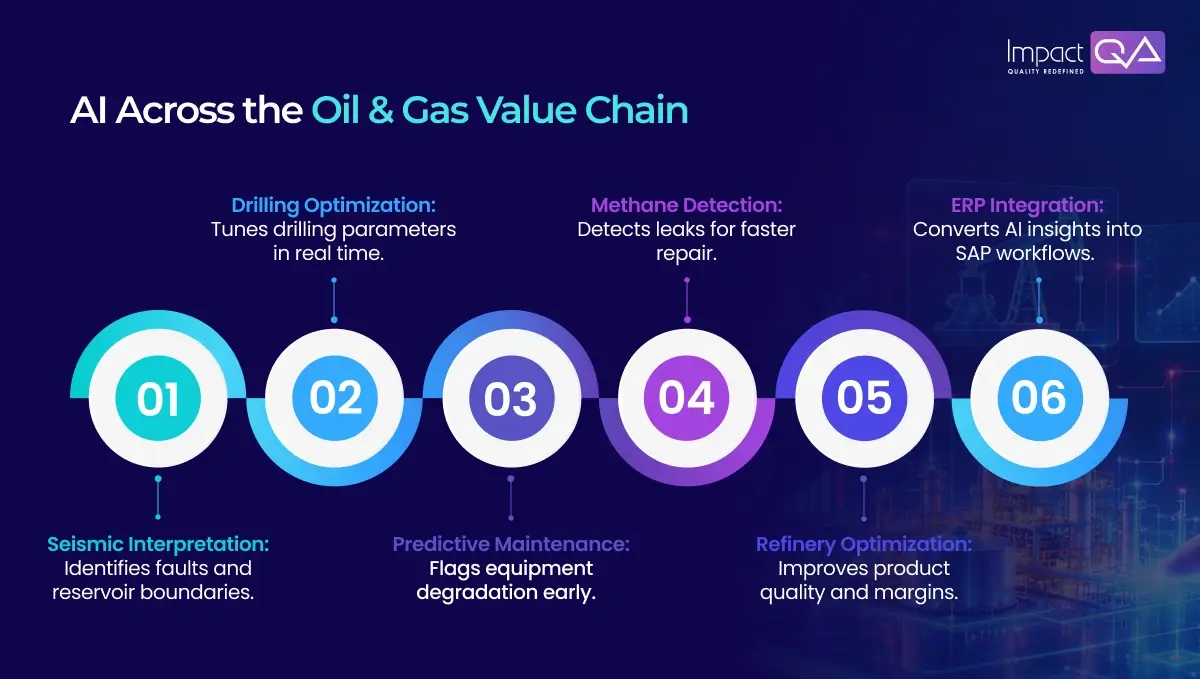
Seismic surveys produce enormous volumes of reflection data. Machine learning models classify faults, salt bodies, and reservoir boundaries faster than manual interpretation, which shortens the path to a drilling decision. The IEA reports that AI can make resource evaluation more reliable and reduce predrilling uncertainty.
The compute behind this is substantial. Oil and gas companies operated 24 of the world’s 500 fastest supercomputers in 2024, compared with 11 in 2000.
2. Drilling Optimization at the Edge
Offshore rigs and frac sites often run with limited connectivity. Models deployed at the edge process downhole sensor data on-site and adjust parameters such as weight on bit and rotation speed in real time. Edge deployments are growing at a 14.15% CAGR because remote drill ships and offshore platforms need low-latency inference.
The IEA estimates AI-led interventions could cut the cost of finding, developing, and operating a new deepwater offshore project by up to 10%.
3. Predictive Maintenance for Production Assets
Compressors, pumps, and turbines rarely fail without warning. Vibration, temperature, and pressure readings shift weeks before a breakdown. Models trained on that history flag degradation early, turning emergency shutdowns into planned work orders. Predictive maintenance accounted for 37.60% of 2025 AI spending in the sector, the largest share of any application.
AI in Midstream: Pipelines, Storage, and Emissions
Midstream AI focuses on energy solutions for oil and gas industry priorities that combine safety, compliance, and product recovery.
1. Methane and Leak Detection
Fugitive emissions make up about 20% of methane emissions from oil and gas operations. They are hard to find because they are small, intermittent, and spread across thousands of components. AI models combine satellite imagery, aerial surveys, and fixed sensor data to locate leaks and prioritize repair crews. Every leak fixed is also product recovered.
2. Pipeline Integrity and Scheduling
Inline inspection tools generate corrosion and wall-thickness readings across hundreds of miles of pipe. Machine learning ranks anomalies by growth rate and consequence, so integrity teams excavate where risk concentrates. Scheduling models balance batch sequencing, tank capacity, and shipper nominations as demand shifts.
AI in Downstream: Refining and Trading
1. Refinery Process Optimization
Refinery margins depend on the spread between crude cost and product value. Planning models set targets, yet feed quality and unit conditions change faster than those models update. Machine learning narrows that gap by predicting product quality and unit constraints in near real time.
In one McKinsey case, custom ML models powered a global optimizer for a European refiner. The optimizer minimized quality giveaway, meaning product made better than the specification requires and sold without a premium, and it delivered a $0.3 per barrel margin improvement, equal to five percent of variable operating margin.
2. Trading and Risk Management
Trading desks apply AI to price forecasting, position monitoring, and exposure reconciliation. These models feed commodity and energy trading and risk management (C/ETRM) platforms such as Openlink Endur, Allegro, and RightAngle. Their accuracy depends on clean data inside those platforms, a dependency covered in our analysis of optimizing CTRM solutions through advanced QA.
Where AI Meets Oil and Gas Industry Software
AI models generate predictions. Oil and gas industry software acts on them.
1. ERP Solutions for the Oil and Gas Industry
ERP solutions for the oil and gas industry close the loop between insight and execution. A predictive maintenance alert becomes a work order in SAP Plant Maintenance. A methane reading lands in SAP EHS for regulatory reporting. Production volumes flow into IS-Oil for hydrocarbon accounting.
When an integration drops a field or maps a unit incorrectly, the AI insight never reaches the crew. Our look at SAP testing for oil and gas safety and compliance explains how these workflows break during upgrades.
2. Validating AI Inside Oil and Gas Industry Software Solutions
AI components behave probabilistically, so pass/fail testing misses drift and edge-case behavior. Oil and gas industry software solutions need validation against volatile scenarios such as price shocks, sensor dropouts, and transport delays. The approach is outlined in AI-driven testing for regulated industries.
How ImpactQA Supports AI Programs in Oil and Gas
- SAP testing: Coverage across IS-Oil, PM, EHS, MM, SD, and FI/CO, including interfaces with CTRM, LIMS, terminal automation, and pipeline systems.
- E/CTRM testing: Functional, integration, and performance validation for Openlink Endur, Allegro, and RightAngle.
- AI testing: Scenario-driven risk testing for AI components in regulated operations.
- Test automation: Regression automation for SAP and CTRM upgrade cycles.
- Gen AI development: Self-hosted AI agents and RAG systems deployed within client infrastructure.
ImpactQA tests AI-enabled oil and gas workflows against real-world scenarios and quality risks.
Final Say
AI in oil and gas is shifting toward integrated decision systems. Early programs targeted single problems, such as one compressor fleet or one seismic volume. The next wave links predictions directly to planning, trading, and maintenance execution. That moves investment toward the connective layer: ERP integrations, CTRM data quality, and model governance.
Oil and gas testing companies that validate this layer will scale AI faster, because every model output reaches operations intact. Edge deployments are already outpacing the broader market, which signals where enterprise budgets are heading next.
Get an inside look at the strategy behind the success.
Frequently Asked Questions (FAQs)
Share this post


Related Posts
Our Case Studies