Quick Summary:
Traditional automation is highly reliable for workflows with clearly defined inputs, expected conditions, and measurable outcomes. AI testing doesn’t replace that, it fills in the specific gaps traditional automation was never shaped to reach, chatbot responses that vary by design, UI elements that shift, risk that isn’t spread evenly across changes. This piece walks through 5 of those gaps, each grounded in what Gartner’s research on AI-augmented testing tools and OWASP’s guidance on AI system risk actually say these capabilities do.
Table of Contents:
- Introduction
- About Traditional Automation and AI Automation
- 5 Areas Where AI Testing Solutions Catch What Traditional Tools Miss
- Final Say
- Frequently Asked Questions
A login test has a simple oracle: the thing that defines a correct result. HTTP 200, dashboard displayed, done. Traditional automation is genuinely good at this, and with tolerance rules, statistical assertions, and schema validation, it can stretch to handle a fair amount of variability too.
An LLM response requires a different kind of test oracle. “Correct” for a chatbot answer means something closer to: grounded in the source material, factually accurate, consistent with business rules, and stable enough across runs to trust. That’s a harder thing to check, not because traditional automation is incapable, but because the definition of correct has changed shape entirely.
That shift, from checking a single predetermined result to evaluating behavior against several quality criteria, is where AI testing requires a different approach. The five areas below cover where that shift shows up in practice, and where a scripted test still does the job perfectly well.
ImpactQA's AI-powered test automation flags high-risk areas before testing even begins.
About Traditional Automation and AI Automation
Picture traditional automation as a circle. It’s complete for what it’s built to do: give it the same input, get the same result, every time, with total reliability on workflows that don’t change. That completeness is exactly why regression suites lean on it so heavily, and nothing below changes that.
AI automation doesn’t redraw the circle. It fills in a few specific arcs the circle was never shaped to reach in the first place: outputs that vary on purpose, UI elements that shift position, risk that isn’t spread evenly across changes. Gartner’s research on AI and software testing tracks these arcs directly, self-healing, defect prediction, test orchestration, and evaluation of generative AI applications and agents, as the capabilities defining this space right now. The five below are those arcs, one at a time.
5 Areas Where AI Testing Solutions Catch What Traditional Tools Miss
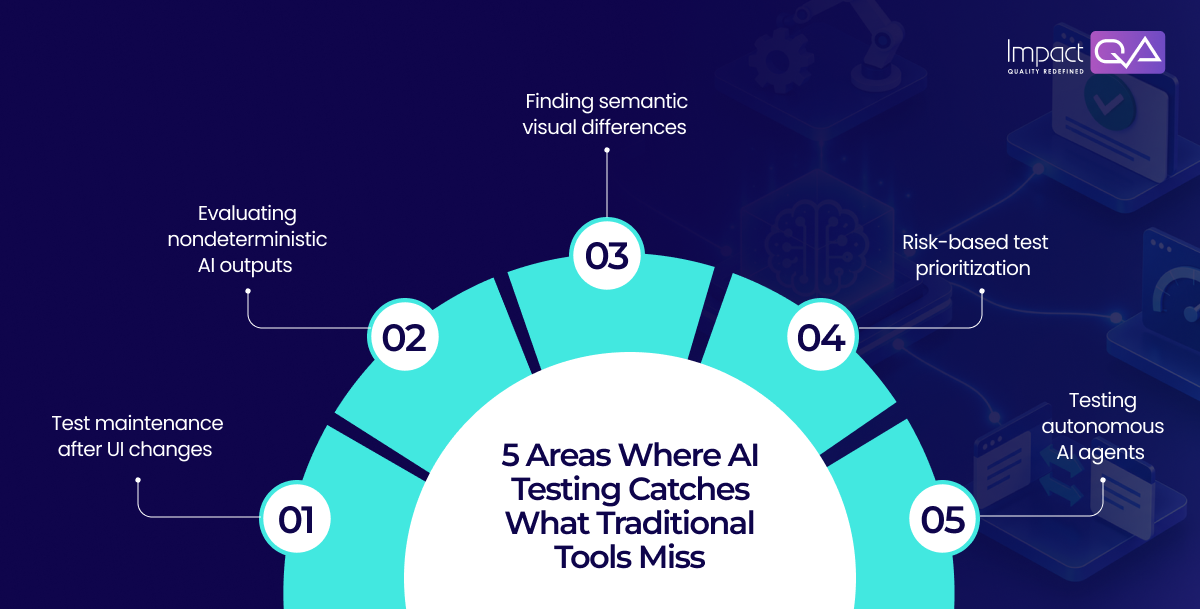
1. Test Maintenance After UI Changes
Traditional scripts often depend on specific locators, so a changed ID, selector, or element structure can affect dozens of tests at once. What happens next matters more than the breakage itself: teams under time pressure often label these failures “flaky” and move on, which means a genuine regression hiding behind a broken locator can slip through right alongside the false alarms.
This is the arc AI fills in.
Self-healing frameworks re-anchor to the same element using multiple attributes instead of one fixed identifier, which clears out most of that noise and leaves real failures easier to spot.
2. Evaluating Nondeterministic AI Outputs
A traditional assertion checks for one exact expected string, which breaks down fast against a chatbot that’s designed to phrase the same answer differently each time. This is where AI testing draws on several distinct checks instead of one: groundedness, whether a response stays supported by the source material it’s meant to reflect; factual accuracy, whether the claims hold up; instruction adherence, whether it follows the business rules it was given; and robustness, whether it holds up under an ambiguous or adversarial prompt.
OWASP’s 2025 LLM guidance identifies several of these risks directly, including prompt injection and excessive agency.
3. Finding Semantic Visual Differences
Pixel-level visual regression tools have existed for years and do their job, at the cost of flagging plenty of harmless noise along the way: font rendering differences, anti-aliasing, animation timing. AI-assisted visual analysis can help distinguish meaningful UI changes from low-value rendering differences. That’s a narrower, more useful question than “did anything change,” and it’s the part pixel-diffing alone tends to struggle with.
4. Risk-Based Test Prioritization
A standard regression suite runs the same full set of tests regardless of what actually changed, treating a one-line copy edit the same as a change to the payment flow. AI can analyze historical defect patterns and other testing data to identify areas of a recent change that may carry higher defect risk.
Worth being precise here: this points to risk, it doesn’t find the bug itself. The actual defect still gets caught by a test, run by a person or a script, just aimed at the right place sooner.
5. Testing Autonomous AI Agents
Traditional testing checks whether an output is correct. AI automation agents that take action and make decisions on their own raise a different question entirely: not just what it says, but what it’s permitted to do, and whether it stays inside its intended boundaries once a situation gets ambiguous.
OWASP’s guidance on excessive agency describes this risk precisely.
This is the arc that didn’t really exist a few years ago and now needs its own coverage: task planning and goal decomposition, how an agent breaks a broad objective into steps; coordination across multiple agents, where message ordering and state sync matter; and policy enforcement, whether the agent respects role boundaries and escalates correctly instead of acting past its authority.
ImpactQA combines both under one QA strategy built around your systems.
Will AI Take Over Software Testing?
Not in the way that question usually implies. AI testing services absorb the repetitive, pattern-based, high-volume work: regression execution, locator maintenance, response consistency checks, visual comparison across hundreds of screen sizes. What they don’t absorb is judgment. Deciding whether a new checkout flow actually makes business sense, whether an error message would genuinely confuse a real user, or whether an edge case is worth building a whole test suite around, that’s still a human call.
The honest version of this shift looks less like replacement and more like division of labor. AI agents for automation handle volume and variability. People handle judgment and context. Teams that frame it as one replacing the other tend to either resist AI testing entirely or over-trust it completely, and both mistakes cost more than the balanced version would have.
Final Say
None of these five arcs are fixed in place. Two years ago, agentic AI testing wasn’t a category many budgeted for; a few years from now, some other kind of software will open a gap traditional automation was never shaped to reach, the same way LLMs did. The habit worth keeping isn’t the list above so much as the instinct behind it: notice which fixed assumption a new kind of system just broke, and build the check around that instead of stretching an old assertion further than it should go.
ImpactQA works from that same instinct, pairing established automation with AI-driven testing built for whichever arc a system currently sits in.
Frequently Asked Questions (FAQs)
Share this post


Related Posts
Our Case Studies