Quick Summary:
A 60% reduction in SAP testing cycle time sounds like a marketing number until it’s broken into the phases that actually make it up. This piece grounds that figure in SAP’s own SAP Agentic AI Framework, walks through where a typical testing cycle loses the most time, then maps exactly which phases agentic AI compresses and by how much. It closes with the honest limit: what this doesn’t replace, and why that matters for anyone evaluating SAP testing services built around this shift.
Table of Contents:
- Introduction
- What Is the SAP Agentic AI Framework?
- Where a SAP Testing Cycle Actually Loses Time
- How Agentic AI Compresses Each Phase to Reduce SAP Testing Cycle by 60%?
- What This Doesn’t Replace
- Final Say
- Frequently Asked Questions
Sixty percent is a specific enough number that it deserves a specific explanation, not a general one about AI being smarter than scripts. A SAP testing cycle isn’t one activity that gets faster all at once. It’s many phases, each with its own bottleneck, and agentic AI in SAP doesn’t compress all of them by the same amount or through the same mechanism.
Understanding where the time actually comes from is what separates a defensible number from an inflated one.
This article breaks the SAP testing cycle into five phases, shows where agentic AI can reduce manual effort, and explains why a 60%+ reduction should be treated as a scenario-based target rather than a universal benchmark.
ImpactQA uses agentic AI to generate test cases from SAP requirements and business scenarios.
What Is the SAP Agentic AI Framework?
SAP defines agentic AI as an approach where AI agents use enterprise context, governed access, and reasoning to work through multi-step objectives and execute actions across SAP workflows, rather than responding to isolated prompts one at a time. The SAP Agentic AI Framework brings this together through SAP AI Core, Generative AI Hub, Joule Studio, SAP Business Data Cloud, and governed runtime infrastructure, with identity, integration, and observability layers wrapped around the whole thing so agents operate in production without losing control.
At SAP Sapphire 2026, SAP and Anthropic announced plans to expand Claude’s role across this framework and Joule, positioning stronger reasoning capability specifically for use cases spanning finance, HR, procurement, and supply chain, the same modules that make SAP testing so interconnected in the first place. That framework, not agentic AI as a general concept, is what actually determines where testing cycle time gets saved.
Where a SAP Testing Cycle Actually Loses Time
Most SAP testing estimates focus on execution time and stop there, which misses most of the actual cost. A realistic breakdown looks more like this: test design and case creation, test execution itself, ongoing maintenance as the system changes, regression testing after every update, and validation plus reporting at the end. Execution is often the smallest of these five once a suite matures.
Design and maintenance tend to be where the real hours disappear, which is exactly why a testing strategy that only automates execution rarely gets anywhere near a 60% reduction.
How Agentic AI Compresses Each Phase to Reduce SAP Testing Cycle by 60%?
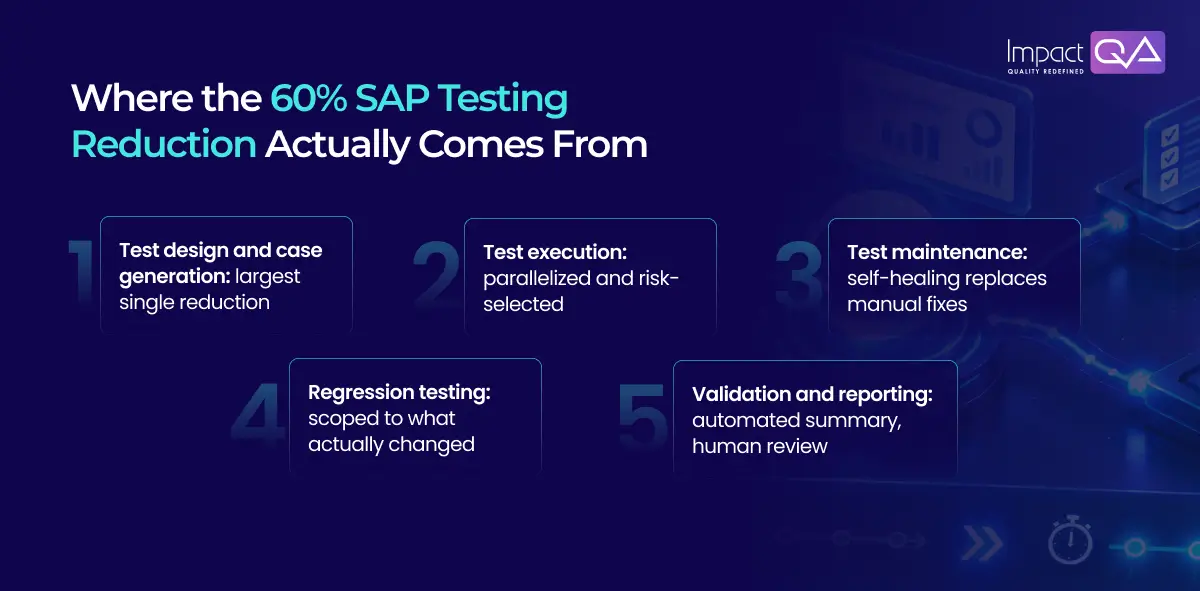
1. Test Design and Case Generation
Traditional test design starts with a person reading requirements documents and manually writing test cases to match.
Agentic AI in this phase extracts both explicit and implicit objectives directly from user stories, configuration data, and existing documentation, then generates context-aware test cases without a script being coded by hand. This phase alone tends to shrink the most, since manual case-writing was rarely the bottleneck engineers wanted to keep.
2. Test Execution
Execution compresses through parallelization and dynamic test selection rather than simply running scripts faster. An agent evaluates current risk, recent change history, and system load, then selects and modifies which tests actually need to run instead of replaying the full suite every time regardless of what changed.
3. Test Maintenance
This is the phase that eats the most hours in a traditional SAP suite, since every quarterly update or configuration change breaks scripts tied to fixed UI elements or field IDs. Capgemini’s World Quality Report puts ongoing test maintenance at 25 to 50% of QA budget even in mature automation suites, which makes this phase the single largest lever available.
Self-healing agents that re-anchor to elements automatically, rather than requiring a person to manually update forty broken scripts, are what actually move this number.
4. Regression Testing
Regression testing under a scripted approach runs the same fixed suite regardless of what changed, which wastes cycles on low-risk areas while sometimes under-covering high-risk ones.
Agentic AI services narrows regression scope to what recent changes actually touched, using dependency mapping across SAP’s interconnected modules, so a change in procurement doesn’t require re-running the entire finance suite by default.
5. Validation and Reporting
Final validation and reporting traditionally involves someone manually compiling results across multiple test runs into a single summary. Agentic systems consolidate this automatically, flagging anomalies against expected business behavior rather than just pass or fail status, cutting the compilation step down from hours to something closer to a review task.
What This Doesn’t Replace
Gartner projects that by 2030, more than half of routine ERP tasks will be handled autonomously by AI, which leaves the other half firmly in human hands, and testing is no exception to that split.
Agentic AI absorbs the repetitive and pattern-based work: case generation, execution selection, maintenance, regression scoping. It doesn’t decide whether a new approval workflow makes business sense, doesn’t own the final risk sign-off before a production release, and doesn’t replace the governance layer that determines whether an agent’s own test coverage is actually adequate.
SAP QA testing services built around this shift still need someone accountable for that judgment, which is exactly why the framework SAP built includes identity and governance layers alongside the reasoning ones.
ImpactQA uses agentic AI to support risk-based test selection and faster execution across SAP workflows.
Final Say
The 60% figure holds up when it’s tied to specific phases, mainly test design, maintenance, and regression scoping, rather than claimed as a blanket number across an entire testing cycle. Execution alone rarely gets there. Maintenance, historically the most expensive phase in any mature SAP suite, is where most of that number actually comes from.
ImpactQA builds SAP test automation services around this exact phase-by-phase reality, working within SAP’s own Agentic AI Framework rather than layering a generic AI tool on top of it, so the reduction a client sees maps to something real.
Frequently Asked Questions (FAQs)
Share this post


Related Posts
Our Case Studies