Quick Summary:
AI is changing healthcare software testing at two levels: it is making conventional QA more intelligent, while also creating new testing requirements for AI-enabled healthcare applications. From generating test scenarios and prioritizing regression coverage to validating models, data, privacy, and real-world AI behavior, modern QA is moving beyond scripted functional checks. This article explores five practical ways AI is reshaping healthcare software testing and what that means for quality engineering teams.
Table of Contents:
- Introduction
- How AI Is Transforming Healthcare Software Testing? 5 Ways
- What This Means for Healthcare Software Testing Services?
- Final Say
- Frequently Asked Questions
Healthcare is a sector in perpetual transformation, and software has long driven that shift. To understand what’s changing now, ask a simple question: is the system merely executing a rule, or interpreting something?
For years, QA was built around the first case. A tester defined an expected behavior, automation executed it, and the result was checked against a known outcome. Rule in, outcome out, verified.
Healthcare software no longer fits that model. It’s not just recording information or moving requests between screens. Increasingly, it’s making inferences, sometimes influencing decisions consequential to patients. That’s AI.
McKinsey’s Q4 2025 US healthcare survey found that half of healthcare leaders had implemented generative AI, and over 80% had deployed their first use cases. The FDA has now authorized more than 1,300 AI-enabled medical devices.
So, the question isn’t whether AI belongs in healthcare software, because it already does. Better it is sensible to ask what happens to quality when software starts inferring rather than following instructions.
That’s where AI in healthcare software testing takes on new meaning. This includes expanding scenarios, generating test data, prioritizing regression, spotting failure patterns, and even testing AI models themselves. It’s changing both how software is tested, and what needs testing. This article examines this shift closely.
Let ImpactQA test its performance, security, and accuracy before Go-Live.
How AI Is Transforming Healthcare Software Testing? 5 Ways
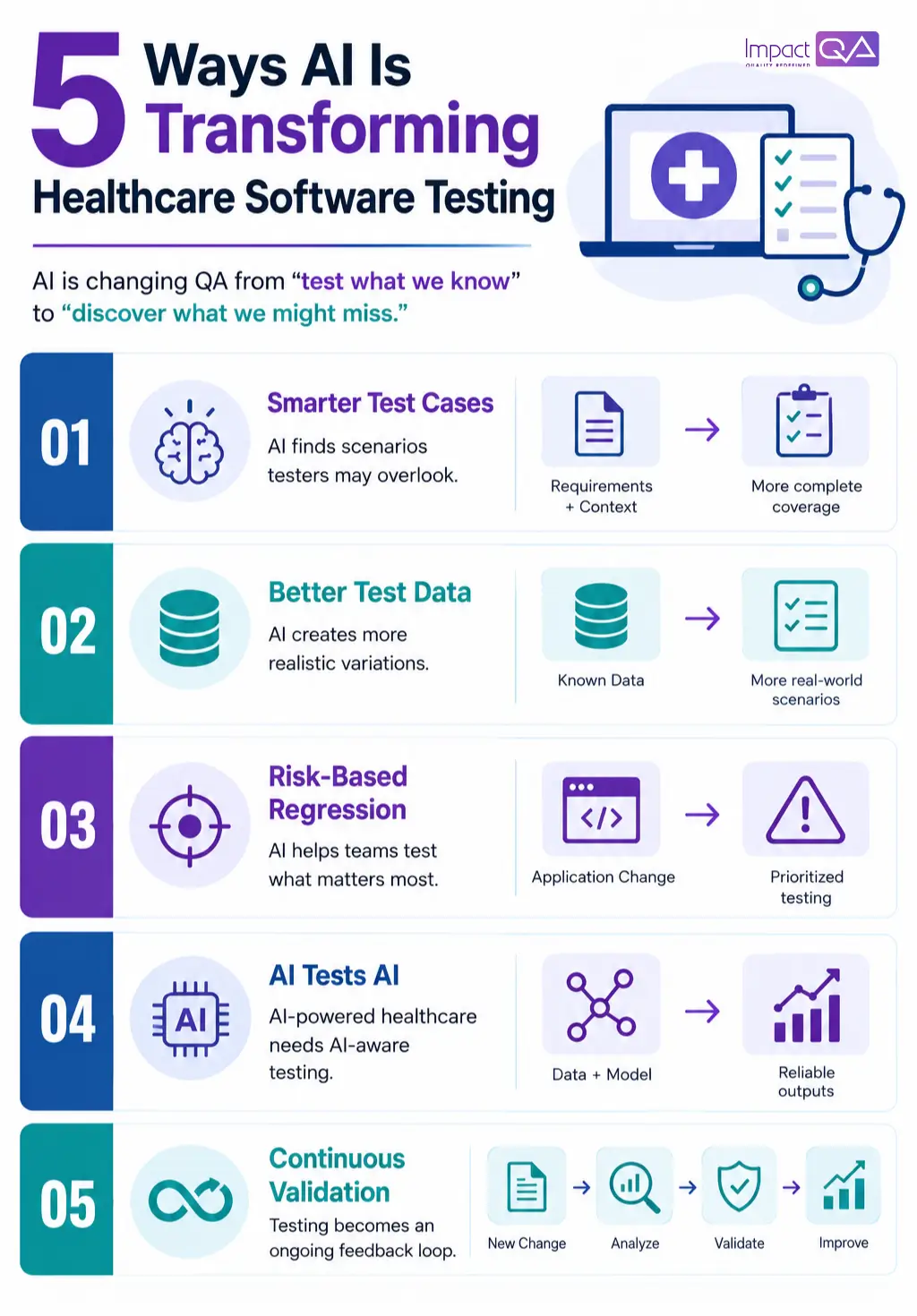
The interesting part is that AI does not replace the testing process overnight. Instead, it starts changing individual parts of it like making some activities smarter, some faster, and some far more dynamic.
Let’s understand where AI is reshaping healthcare software testing services.
1. AI Is Making Test Case Generation Smarter
Good testing starts with asking the right questions. The problem is that even experienced testers cannot always think of every possible question at the start.
Traditional test creation usually begins with a requirement or user story. Testers interpret it, identify relevant scenarios, create test cases, and automate the cases that need to be repeated.
AI can help widen that starting point by looking at requirements alongside application behavior, previous test cases, related workflows, and available test data.
Consider a healthcare application used by physicians to review patient records and place medication orders. A conventional test plan may cover valid orders, missing fields, incorrect inputs, and authorization rules.
AI can take that familiar test plan a step further by highlighting situations that may be easy to overlook, such as unusual patient ages, medication combinations, incomplete records, or dependencies between connected workflows.
The tester remains in control. AI simply helps cast a wider net when testing healthcare software.
2. AI Is Creating More Realistic Healthcare Test Data
Test scenarios are only half the story. The other half is the data used to validate them.
Healthcare applications rely on complex clinical, demographic, financial, administrative, and operational data. While fixed datasets can verify known conditions, AI can expand coverage by generating data across edge cases, uncommon combinations, and boundary conditions.
For example, a patient-management application could be tested against many different profile combinations instead of repeatedly using the same few records. Claims, prescriptions, payments, and diagnostic workflows can benefit from the same broader range of scenarios.
This gives automated software testing in healthcare a more varied set of conditions to work with and gives testers a better chance of finding problems before users do.
3. AI Is Making Regression Testing More Risk-Based
Regression testing can feel a little like checking every room in a building because one light switch was replaced. It is thorough, but not always practical at scale.
Healthcare applications are highly connected, so even a small change can affect several workflows.
AI can help make that process more focused. Rather than giving every test the same priority, it can look at what changed, trace related workflows, consider previous failures, and identify the areas most likely to be affected.
Imagine a release changes the medication-ordering process. Instead of simply running through a massive list and hoping the important scenarios rise to the surface, AI can help identify which connected workflows deserve attention first.
The goal is not to test less. It is to spend testing effort where it is most likely to matter.
4. AI Is Changing What Healthcare Software Testing Has to Validate
This is where the conversation gets more interesting: sometimes AI is not just helping you test the software. AI is the software you need to test.
When healthcare applications use AI for diagnosis, prediction, clinical decision support, or other intelligent functions, checking whether a button works or a screen loads correctly is no longer enough.
Teams also need to understand whether the AI behaves appropriately.
For example:
- Does it respond consistently to similar inputs?
- What happens when the data changes?
- How does it handle incomplete or unusual information?
- Does the output stay within the intended use of the application?
- What changes after the model is updated or retrained?
These questions bring model validation, data validation, performance evaluation, and scenario-based testing into AI applications in healthcare software testing.
The AMA’s physician AI research found 66% of physicians reported using AI in 2024, almost double the share reported the year before. So, in a sense, QA now has two jobs:
- Use AI to make testing more intelligent.
- Test the AI to make healthcare software more dependable.
5. AI Is Enabling Continuous Testing and Validation
Software used to be tested in cycles. Build it, test it, fix it, release it, and repeat. AI is helping turn that cycle into more of a feedback loop.
Healthcare applications rarely work alone. They connect with EHRs, APIs, medical devices, identity platforms, cloud services, and third-party systems. AI models introduce another layer that can change how the application behaves.
AI can help teams spot anomalies, compare behavior over time, analyze release changes, generate new scenarios from emerging patterns, and decide where deeper validation may be needed.
That means testing can become more continuous rather than something that happens only when a release is approaching.
And in healthcare, that continuity matters. Quality is not only about whether the application works. Privacy, security, safety, transparency, data quality, and human oversight also need to remain part of the picture.
What This Means for Healthcare Software Testing Services?
The larger shift is therefore not simply about adding AI to an existing QA toolkit. It is about changing what the toolkit needs to accomplish.
AI can make established QA activities more intelligent:
- Test generation becomes more contextual,
- Test data becomes more varied,
- Regression becomes more targeted, and
- Defect analysis becomes more informed.
At the same time, AI creates entirely new testing needs. Models need to be validated. Outputs need to be evaluated. Data needs to be examined. Model versions need to be compared. AI-driven workflows need to be observed as they evolve.
For healthcare software testing companies, that means the real advantage will not come from using AI for its own sake. It will come from knowing where AI can strengthen the testing lifecycle, and where traditional testing still provides the necessary foundation.
ImpactQA checks healthcare apps using AI for critical issues before they reach users.
Final Say
AI is transforming healthcare software testing in two ways: it is making traditional QA smarter while also creating new testing requirements for AI-powered healthcare applications.
It is helping QA teams ask better questions, work with broader scenarios, focus attention where risk is higher, and understand intelligent application behavior more deeply.
The result is a broader definition of quality. For modern healthcare applications, it is no longer enough to ask, “Does it work?” The better question is, “Does it continue to behave the way it should as the data, workflows, and intelligence behind it change?”
Frequently Asked Questions (FAQs)
Share this post


Related Posts
Our Case Studies