Quick Summary:
Reliable autonomous AI adoption remains challenging when governance, transparency, and validation are not addressed from the outset. This blog examines how agentic AI services introduce new operational considerations, explains why AI testing and AI testing services are essential, and outlines governance principles, enterprise risks, and best practices that enable organizations to deploy intelligent AI systems with confidence and control.
Table of Contents:
- Introduction
- Why Agentic AI Requires a New Governance Model
- Managing Enterprise Risks While Scaling Agentic AI
- Best Practices for Responsible Agentic AI Adoption
- Conclusion
Agentic AI services are changing how enterprises execute complex business operations by enabling autonomous decision making, multi-step reasoning, and task execution with minimal human intervention. Unlike conventional automation, these intelligent systems can interpret objectives, plan workflows, interact with multiple applications, and continuously refine outcomes based on contextual inputs. While this advancement creates new opportunities, it also introduces governance, security, and reliability concerns that organizations cannot overlook.
As enterprises expand investments in AI testing, a structured governance strategy becomes indispensable. Organizations increasingly depend on AI testing services to validate autonomous systems before deployment. At the same time, AI in software testing is becoming essential for evaluating reasoning accuracy, safety controls, and operational consistency. A robust AI testing solution ensures that autonomous AI systems remain transparent, secure, compliant, and aligned with enterprise objectives throughout their lifecycle.
At ImpactQA, we help enterprises manage AI risks with strong governance, compliance, and practical adoption strategies.
Why Agentic AI Requires a New Governance Model
Traditional governance models were designed for deterministic software that follows predefined logic. Agentic AI services operate differently because they make decisions based on contextual understanding, external data, and dynamic reasoning. Consequently, enterprises cannot rely solely on conventional validation methods. Governance must extend beyond code quality and include behavioral evaluation, accountability, and continuous oversight. This shift makes AI and software testing a strategic business requirement rather than a technical checkpoint.
A comprehensive governance framework addresses several operational dimensions that directly influence enterprise adoption.
1. Decision Transparency
Autonomous AI systems should provide traceable reasoning for every critical decision. Transparent execution logs enable stakeholders to understand how outputs were generated and whether the reasoning aligns with organizational policies. This visibility simplifies audits while reducing uncertainty during production incidents.
2. Risk-Based Validation
Not every autonomous action carries the same level of business impact. Organizations should classify AI decisions according to operational risk and apply proportional validation strategies. High risk workflows require deeper verification before execution, while lower risk activities may permit greater autonomy with appropriate monitoring.
3. Continuous Behavioral Monitoring
Static validation cannot guarantee reliable performance because autonomous agents continuously interact with changing business environments. Continuous monitoring detects behavioral drift, unexpected execution paths, and declining response quality before these issues affect production systems. This ongoing assessment strengthens operational stability over time.
4. Security and Permission Controls
AI automation agents frequently access enterprise applications, sensitive databases, and external services. Strict identity management, permission boundaries, and activity logging reduce unauthorized actions and strengthen enterprise security. Controlled access also simplifies regulatory compliance across distributed digital ecosystems.
5. Human Oversight for Critical Decisions
Certain business functions should always include human approval regardless of AI maturity. Financial transactions, legal commitments, healthcare recommendations, and regulatory reporting require human validation before execution. Such governance mechanisms reduce operational exposure while maintaining accountability.
6. Comprehensive Validation Through AI Testing
Organizations must evaluate reasoning accuracy, workflow execution, resilience, and exception handling using structured AI Testing methodologies. Advanced AI testing services combine functional validation, security verification, and behavioral analysis to identify weaknesses before deployment. Additionally, LLM testing validates language reasoning under diverse enterprise scenarios, while chatbot testing evaluates conversational accuracy, contextual consistency, and response reliability across customer interactions.
Managing Enterprise Risks While Scaling Agentic AI
Deploying agentic AI services at an enterprise scale demands more than functional validation. Autonomous systems continuously interact with applications, APIs, databases, and users, making them susceptible to security, compliance, and operational challenges. Without structured controls, a single inaccurate decision can trigger downstream business disruptions. Organizations should therefore establish preventive measures before expanding AI adoption. A mature governance strategy, supported by AI testing and continuous validation, reduces uncertainty while maintaining business reliability.
1. Address Data Quality and Privacy Risks
Agentic AI systems depend on high-quality data to make reliable decisions. Incomplete, outdated, or biased datasets can influence reasoning and produce inconsistent outcomes. Organizations should implement strong data governance, privacy safeguards, and regular validation to ensure every AI testing solution evaluates models against trusted and representative datasets.
2. Control Autonomous Decision Boundaries
Not every workflow should be fully autonomous. Enterprises should define clear operational limits for AI agents for automation, particularly when financial approvals, compliance decisions, or customer commitments are involved. Human intervention at critical checkpoints improves accountability without limiting automation benefits.
3. Strengthen Security Against Emerging Threats
Autonomous agents often access multiple enterprise platforms during task execution. This broad connectivity increases the attack surface. Security assessments, access controls, and AI testing services should verify authentication mechanisms, permission management, and vulnerability exposure before production deployment.
4. Detect Model Drift and Behavioral Changes
AI models can gradually change their responses as business environments and input data evolve. Continuous monitoring, supported by AI in software testing, helps identify unexpected behavior before it affects enterprise operations. Regular reassessment also ensures consistent business performance over time.
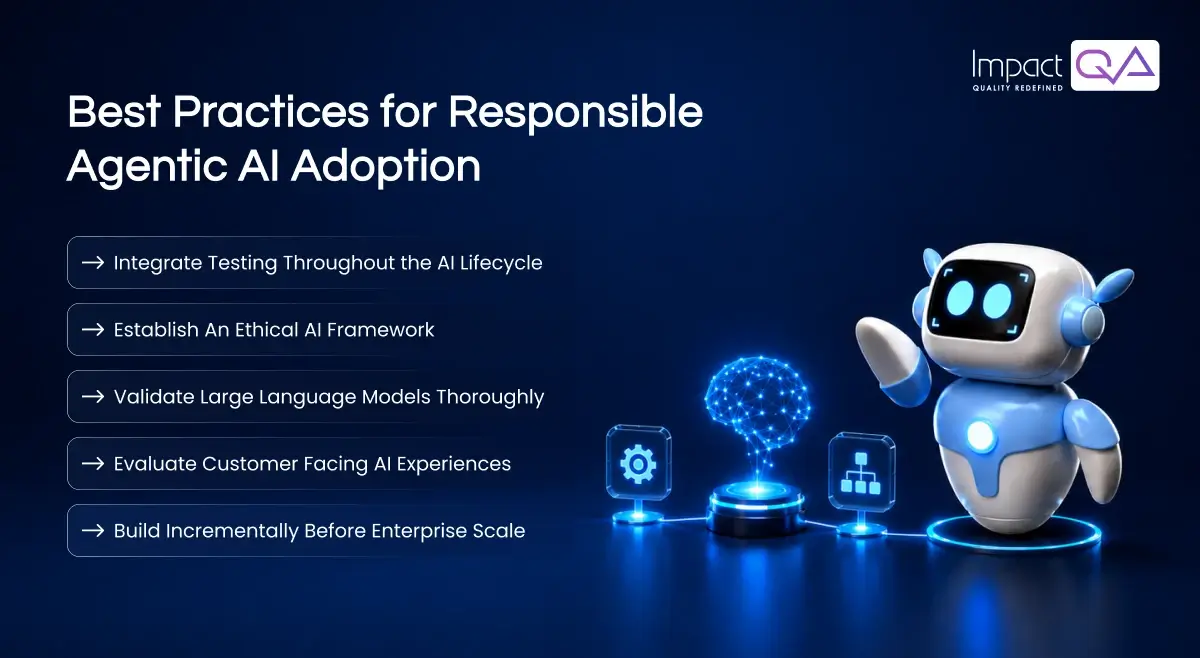
Best Practices for Responsible Agentic AI Adoption
Successful adoption depends on balancing innovation with governance. Enterprises should build structured implementation strategies that prioritize reliability, compliance, and measurable business outcomes. Combining AI and software testing with governance practices allows organizations to deploy intelligent automation confidently while reducing operational uncertainty.
1. Integrate Testing Throughout the AI Lifecycle
Validation should begin during development and continue after deployment. AI Testing should examine functional behavior, reasoning accuracy, performance, and security across changing enterprise conditions. Continuous verification reduces production risks while supporting reliable system evolution.
2. Establish An Ethical AI Framework
Responsible AI adoption requires policies that address fairness, transparency, accountability, and regulatory compliance. An ethical AI framework provides consistent guidance for model development, deployment, monitoring, and governance while strengthening stakeholder confidence.
3. Validate Large Language Models Thoroughly
Since many AI agent services rely on foundation models, comprehensive LLM testing is essential. Enterprises should evaluate reasoning quality, hallucination resistance, prompt injection resilience, and contextual consistency before integrating autonomous capabilities into business workflows.
4. Evaluate Customer Facing AI Experiences
Organizations deploying conversational assistants should include chatbot testing as part of their quality strategy. Testing should verify response accuracy, contextual understanding, escalation behavior, and user experience across realistic business scenarios to ensure dependable customer interactions.
5. Build Incrementally Before Enterprise Scale
Rather than adopting the latest technology bandwagon across every business function, organizations should begin with controlled pilot projects. This phased approach allows teams to refine governance, improve AI testing solution capabilities, and validate AI automation agents before expanding enterprise wide.
At ImpactQA, we deliver secure AI governance frameworks, risk assessments, and best practices for sustainable adoption.
Conclusion
Agentic AI services represent a significant advancement in enterprise automation, but their value depends on disciplined governance, continuous validation, and responsible deployment. Organizations must combine AI testing, AI testing services, and AI in software testing to evaluate autonomous decision making, security, compliance, and operational resilience. Likewise, AI and software testing should remain an ongoing practice as models, data, and business environments continue to change. A comprehensive AI testing solution enables enterprises to adopt autonomous intelligence with greater confidence while minimizing operational and regulatory risks.
At ImpactQA, we help enterprises build reliable AI ecosystems through specialized AI Testing, LLM testing, chatbot testing, and comprehensive validation for intelligent applications. Our experts assess AI agent services and agentic AI services against enterprise quality, security, and governance standards to ensure dependable performance at scale. Whether organizations are deploying AI automation agents or expanding AI-driven business workflows, we deliver practical testing strategies that support secure, compliant, and business ready AI adoption.
Share this post


Related Posts
Our Case Studies