Quick Summary:
Frequent Oracle updates make regression testing difficult, but agentic AI is changing the approach. This blog explores how autonomous AI is redefining oracle testing through intelligent decision-making, adaptive automation, and business-aware validation. It explains key capabilities, implementation strategies, enterprise use cases, and adoption considerations for building scalable, future-ready Oracle quality assurance programs.
Table of Contents:
- Introduction
- Why Agentic AI Marks a Fundamental Shift in Oracle Quality Engineering
- Core Capabilities That Differentiate Agentic AI from Conventional Automation
- Where Agentic AI Creates the Highest Business Value Across Oracle Applications
- Building Autonomous Oracle Testing Requires More Than AI Models
- The Expanding Role of AI Across Oracle Functional Validation
- Challenges Organizations Must Address Before Adopting Agentic AI
- Final Say
Continuous cloud updates, quarterly releases, and AI-driven workflows have made enterprise Oracle environments highly dynamic and complex. According to Forrester’s The State of Agentic AI in 2026 report, three-quarters of enterprise leaders are actively adopting agentic AI, driving a massive shift where enterprise software accommodates a distributed workforce of autonomous agents. This rapid transition is reshaping enterprise quality engineering, particularly for Oracle ecosystems where frequent configuration changes and interconnected workflows demand continuous validation rather than periodic testing.
Against this backdrop, oracle testing is moving beyond script-driven automation toward intelligent decision-making. Instead of simply executing predefined test cases, agentic AI evaluates complete business context, prioritizes risks, and adapts application changes independently. Consequently, oracle test automation is becoming more resilient and business-aware, enabling quality teams to validate applications with greater precision while dramatically reducing conventional framework maintenance.
ImpactQA helps enterprises implement AI-driven Oracle testing solutions that improve automation efficiency.
Why Agentic AI Marks a Fundamental Shift in Oracle Quality Engineering
Traditional automation has always relied on predefined instructions. Every workflow, validation point, and expected result must be manually designed before execution begins. While this approach performs adequately for stable applications, Oracle environments rarely remain static for long.
Oracle Fusion Cloud, Oracle ERP, and Oracle HCM continuously receive feature enhancements, UI modifications, security updates, and workflow adjustments. These frequent changes make static automation increasingly susceptible to failures that are unrelated to application quality.
Agentic AI changes this operating model by introducing autonomous reasoning into oracle software testing. Rather than waiting for engineers to update scripts, intelligent agents can:
- Analyze release changes before execution
- Prioritize business-critical regression scenarios
- Generate missing test cases automatically
- Repair broken execution paths where appropriate
- Recommend additional validation based on application behavior
- Learn from historical defects to improve future testing
As a result, Oracle in software testing shifts from task execution toward intelligent quality decision-making. Test automation gradually becomes a continuous analytical process instead of a sequence of scripted activities.
Core Capabilities That Differentiate Agentic AI from Conventional Automation
Agentic AI introduces several intelligent capabilities that significantly expand what automation can accomplish.
1. Context-Aware Test Generation
Instead of producing generic scripts, AI agents understand Oracle business processes such as Procure-to-Pay, Order-to-Cash, Record-to-Report, and Hire-to-Retire. This enables Oracle ERP testing to focus on complete business transactions rather than isolated application screens.
2. Adaptive Workflow Validation
Oracle applications frequently undergo interface modifications after quarterly releases. Agentic AI recognizes these structural changes and adjusts execution paths dynamically, making oracle cloud test automation considerably more resilient than fixed automation scripts.
3. Business-Risk Prioritization
Rather than executing thousands of regression tests equally, autonomous agents identify modules carrying the highest business risk. Consequently, oracle automation testing allocates execution effort where failures would produce the greatest operational impact.
4. Continuous Learning
Every execution contributes to additional knowledge. Failed validations, production incidents, historical defects, and release notes gradually improve future recommendations, making automated oracle testing progressively more intelligent over time.
Where Agentic AI Creates the Highest Business Value Across Oracle Applications
The advantages become particularly evident in enterprise implementations involving multiple Oracle products.
Sr. No. |
Oracle Environment |
How Agentic AI Contributes |
| 1. | Oracle ERP Cloud | Learns financial workflows, validates transaction integrity, predicts regression impact |
| 2. | Oracle HCM | Detects workflow deviations after policy or configuration changes |
| 3. | Oracle SCM | Monitors supply chain scenarios across interconnected modules |
| 4. | Oracle CX | Generates customer journey validations using business context |
| 5. | Oracle EPM | Validates planning models, calculations, and reporting consistency |
These intelligent capabilities significantly improve Oracle cloud test automation by reducing repetitive script maintenance while increasing business coverage.
Moreover, organizations managing hybrid Oracle deployments gain greater visibility into cross-application dependencies that conventional automation frequently overlooks.
Building Autonomous Oracle Testing Requires More Than AI Models
Although agentic AI introduces remarkable intelligence, successful implementation depends on disciplined engineering practices rather than algorithms alone.
1. Develop Structured Business Knowledge
AI agents require complete process understanding. Business rules, approval hierarchies, integrations, and compliance requirements should remain well documented before autonomous execution begins.
2. Maintain Reliable Enterprise Data
High-quality datasets directly influence AI recommendations. Poor master data, inconsistent environments, or incomplete test records reduce the effectiveness of oracle testing tools that rely on intelligent analysis.
3. Combine Human Expertise with Autonomous Reasoning
AI agents excel at discovering patterns and expanding coverage. However, experienced QA professionals continue defining business priorities, reviewing complex scenarios, and validating strategic testing decisions.
4. Integrate Continuously with Delivery Pipelines
Agentic AI performs most effectively when embedded within DevOps pipelines. This allows functional testing oracle environments to validate every configuration change before deployment reaches production.
The Expanding Role of AI Across Oracle Functional Validation
Functional validation has traditionally depended on predefined business scenarios covering user journeys from beginning to end. Agentic AI considerably broadens this capability by understanding why business processes exist instead of merely repeating execution steps.
This enables functional testing oracle initiatives to discover process variations that manual teams may overlook automatically. For example, procurement approvals, invoice matching exceptions, tax calculations, inventory transfers, and payment workflows can all be analyzed through multiple intelligent pathways rather than one scripted sequence.
Additionally, oracle automated testing tools increasingly combine machine learning, process mining, execution analytics, and natural language processing. Together, these technologies allow QA teams to validate larger Oracle implementations without proportional growth in manual effort.
Consequently, oracle testing tools are gradually transforming into intelligent quality advisors capable of recommending both test coverage improvements and release readiness.
Challenges Organizations Must Address Before Adopting Agentic AI
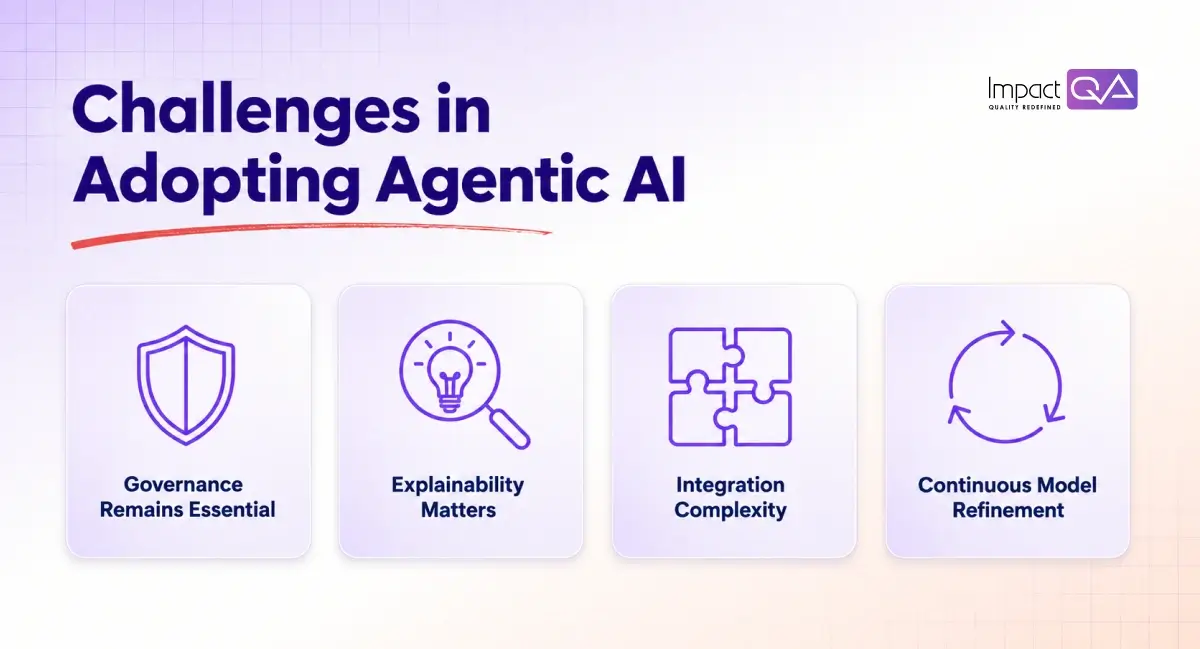
Despite its considerable advantages, autonomous quality assurance introduces several practical considerations that organizations should address carefully.
1. Governance Remains Essential
Autonomous agents require clearly defined operational boundaries. Organizations must determine which testing decisions AI can execute independently and which require human approval.
2. Explainability Matters
Enterprise QA leaders must understand why AI generated a specific recommendation or selected particular regression paths. Transparent decision-making improves trust across business and technical stakeholders.
3. Integration Complexity
Large Oracle implementations often include third-party ERP systems, APIs, legacy databases, middleware, and custom extensions. Agentic AI should evaluate these interconnected ecosystems rather than isolated Oracle modules.
4. Continuous Model Refinement
Business policies, compliance rules, and organizational workflows continue to change. Therefore, AI models supporting Oracle ERP testing require periodic retraining to maintain accuracy across evolving enterprise processes.
ImpactQA enables autonomous Oracle testing with domain expertise and advanced automation strategies.
Final Say
Agentic AI represents meaningful progression rather than another automation trend. By combining reasoning, contextual understanding, adaptive execution, and continuous learning, autonomous agents allow enterprise testing teams to focus on quality strategy instead of repetitive maintenance. Consequently, Oracle software testing is becoming increasingly predictive, intelligent, and aligned with business outcomes rather than isolated technical validations. As Oracle environments continue expanding across cloud, ERP, HCM, SCM, and analytics platforms, autonomous quality assurance will become an essential component of sustainable enterprise delivery.
At ImpactQA, we view this transition as the natural progression of enterprise quality engineering. Our expertise in Oracle ERP testing and intelligent automation frameworks enables us to design autonomous testing strategies that align with complex Oracle ecosystems. By combining domain expertise with AI-driven engineering practices, we help organizations build resilient testing programs that reduce maintenance effort and support continuous business transformation.
Frequently Asked Questions (FAQs)
Share this post


Related Posts
Our Case Studies