Quick Summary:
As Oracle environments grow more complex through cloud adoption, integrations, and continuous updates, maintaining system stability becomes increasingly challenging. A structured Oracle testing strategy helps organizations reduce operational risk, improve performance, and support business continuity. This blog explores the importance of Oracle testing, key quality engineering practices, automation, and risk management approaches that contribute to long-term enterprise stability.
Table of Contents:
- Introduction
- The Business Impact of Oracle System Failures
- Core Elements of an Effective Oracle Testing Strategy
- How Automation Strengthens Oracle Performance and Stability
- Managing Risk Across Oracle Cloud Transformations
- Building a Sustainable Oracle Quality Engineering Framework
- Final Thought
Oracle environments support some of the most business-critical functions within large enterprises. From financial reporting and procurement management to supply chain operations and workforce administration, Oracle applications process massive volumes of data and transactions every day. As organizations continue expanding digital initiatives, application ecosystems become increasingly interconnected through APIs, third-party platforms, customizations, and cloud services. This growing complexity introduces multiple points where defects, performance bottlenecks, and integration failures can affect operational continuity.
A structured approach to Oracle testing plays a significant role in reducing these risks before they impact production systems. Testing is no longer limited to validating functionality after development cycles. Modern quality engineering practices focus on validating business processes, integrations, security controls, data integrity, and system performance throughout the software lifecycle. As enterprises accelerate cloud adoption and modernization programs, well-defined testing strategies become essential for maintaining system reliability to support long-term operational stability.
ImpactQA helps organizations modernize testing programs through automation, performance testing, and risk-focused quality assurance services.
The Business Impact of Oracle System Failures
Oracle platforms serve as the operational backbone for many enterprises. When issues emerge within these systems, the consequences often extend beyond technical teams and directly affect business outcomes. Understanding these risks highlights why Oracle testing requires strategic planning rather than isolated validation activities.
Disruption of Critical Business Processes
Oracle applications support interconnected workflows across departments. A defect introduced during an update can interrupt invoice processing, procurement approvals, inventory management, or payroll activities. Such disruptions frequently create operational delays that impact multiple business functions simultaneously.
Data Integrity and Reporting Risks
Enterprise leaders depend on Oracle-generated reports to make strategic decisions. Errors in calculations, integrations, or data migration processes can produce inaccurate reports. This may lead to incorrect forecasting, financial discrepancies, and regulatory concerns that affect organizational credibility.
Performance Degradation Under Business Load
Many organizations focus primarily on functionality validation while overlooking system performance. In software testing, Oracle must include workload analysis to determine how applications behave during transaction spikes, month-end processing cycles, and peak operational periods.
Security and Compliance Exposure
Oracle platforms often store sensitive financial and employee information. Weak access controls, vulnerable integrations, or configuration issues can create security gaps. Comprehensive testing helps identify these vulnerabilities before they become business risks.
Cloud Transformation Challenges
As enterprises migrate workloads to Oracle Cloud, testing requirements become significantly broader. Oracle Cloud testing validates not only application functionality but also data consistency, user permissions, integrations, and business process continuity throughout migration initiatives.
Core Elements of an Effective Oracle Testing Strategy
A successful testing strategy extends beyond execution cycles. It creates a structured framework that continuously validates system quality while supporting business growth and technology modernization initiatives. Organizations that integrate the components given below into a unified quality strategy will help establish stronger foundations for long-term application reliability:
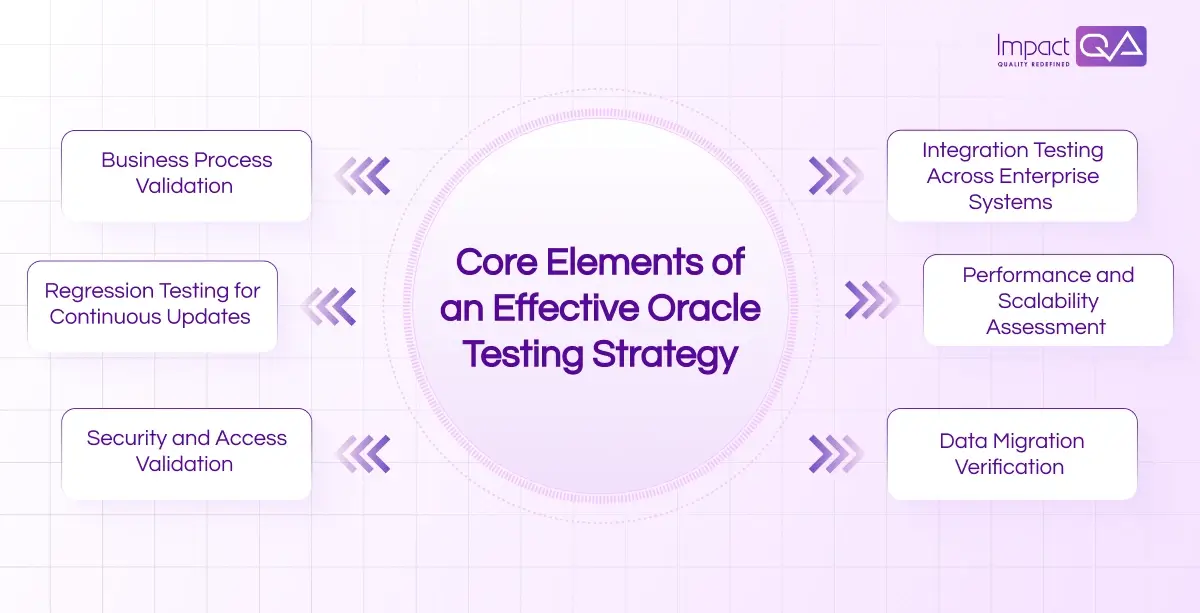
Business Process Validation
Testing should focus on end-to-end workflows rather than isolated transactions. Critical business scenarios must be validated across multiple departments to confirm that interconnected processes function as expected.
Integration Testing Across Enterprise Systems
Oracle applications rarely operate independently. They exchange information with ERP platforms, CRM systems, third-party applications, and external service providers. Oracle software testing must verify that integrations remain stable under varying business conditions.
Regression Testing for Continuous Updates
Frequent application updates introduce new functionality while creating opportunities for unintended defects. Structured regression testing helps organizations verify that existing business processes continue operating correctly after changes are deployed.
Performance and Scalability Assessment
A system that works during low activity periods may struggle during high transaction volumes. Performance testing evaluates response times, resource utilization, and system behavior under realistic operational workloads.
Security and Access Validation
Role-based permissions, segregation-of-duty controls, and authentication mechanisms require regular validation. Testing activities should confirm that users can access only authorized functions and information.
Data Migration Verification
Many Oracle modernization initiatives involve large-scale data migrations. Testing should validate data accuracy, completeness, and consistency before production deployment to minimize business disruption.
How Automation Strengthens Oracle Performance and Stability
The scale and complexity of modern Oracle environments make manual testing increasingly difficult. Automation introduces consistency, repeatability, and efficiency that support enterprise-wide quality objectives.
Accelerated Regression Coverage
Oracle Cloud automated testing enables organizations to execute large regression suites within significantly shorter timeframes. This allows teams to validate extensive business processes without extending release schedules.
Support for Frequent Cloud Updates
Oracle regularly releases updates and enhancements. Oracle Cloud test automation helps organizations assess the impact of these changes quickly while maintaining confidence in business-critical workflows.
Scalable Validation Across Complex Environments
Large enterprises manage thousands of transactions, integrations, and configurations. Oracle Cloud testing supported by automation allows organizations to validate these environments efficiently without increasing testing effort proportionally.
Enhanced Reporting and Visibility
Automation platforms provide detailed execution reports, trend analysis, and quality metrics. These insights help stakeholders make informed decisions regarding releases and system readiness.
Managing Risk Across Oracle Cloud Transformations
Cloud adoption introduces opportunities for agility and scalability, but it also creates new testing challenges. Organizations frequently encounter risks associated with integrations, data migration, user adoption, and performance consistency.
A major challenge involves validating interconnected business processes after migration. Applications may function correctly in isolation while producing unexpected behavior when interacting with external systems. Comprehensive Oracle Cloud automated testing helps identify these issues before deployment.
Another important consideration is configuration management. Oracle Cloud environments often contain extensive workflows, approval hierarchies, and role-based permissions. Testing strategies must verify that configurations align with business requirements and governance policies.
Performance validation also becomes critical during transformation projects. Cloud infrastructure provides scalability, but application performance still depends on workload distribution, integrations, and database efficiency. Testing helps organizations understand system behavior under realistic operational conditions.
Organizations should also establish continuous monitoring and testing mechanisms after deployment. Quality assurance should not end with migration completion. Ongoing validation supports long-term stability as business requirements, integrations, and cloud services continue to evolve.
Building a Sustainable Oracle Quality Engineering Framework
Long-term Oracle stability requires more than project-based testing initiatives. Organizations benefit from establishing continuous quality engineering practices that integrate testing into every stage of the software lifecycle.
Shift Validation Earlier
Testing activities should begin during requirements and design phases. Early validation reduces defect leakage and improves overall project outcomes.
Prioritize Business-Critical Workflows
Risk-based testing focuses resources on processes with the highest operational impact. This approach improves testing efficiency while maintaining meaningful coverage.
Integrate Automation Strategically
Oracle test automation should target repetitive and high-volume validation activities where automation delivers measurable value.
Maintain Continuous Quality Monitoring
Testing should be complemented by production monitoring, performance analysis, and defect trend tracking to identify emerging risks proactively.
Align Quality Metrics with Business Objectives
Quality initiatives become more effective when technical metrics are connected to business outcomes such as transaction reliability, user satisfaction, and operational continuity.
ImpactQA helps enterprises improve quality, reduce disruptions, and support continuous change.
Final Thought
Enterprise Oracle environments support mission-critical operations where stability, performance, and reliability directly influence business outcomes. As applications become increasingly connected through cloud platforms, integrations, and continuous updates, testing must evolve beyond basic functional validation. Organizations require comprehensive quality strategies that address business workflows, security controls, data integrity, scalability, and operational resilience.
This is where specialized Oracle testing expertise becomes valuable. ImpactQA delivers end-to-end Oracle testing services designed to help enterprises validate complex Oracle ecosystems. From Oracle Cloud testing and automation implementation to performance engineering, regression validation, integration testing, and cloud migration support, our teams help organizations reduce risk while maintaining system reliability. By combining domain knowledge with advanced quality engineering practices, we enable enterprises to achieve stable Oracle environments that support long-term business objectives.
Share this post


Related Posts
Our Case Studies