Quick Summary:
Modern enterprise environments demand constant innovation, driving a rapid shift to cloud-first architectures. Migrating legacy workloads to Oracle Cloud Infrastructure presents unique validation challenges, as manual processes cannot keep up with frequent updates. This blog examines the primary risks of cloud migration, outlines technical hurdles in end-to-end validation, and presents advanced automation strategies to maintain business continuity and optimize software investments.
Table of Contents:
- Introduction
- Structural Bottlenecks in the Oracle Cloud Update Lifecycle
- Quantifying Operational Risks and Business Disruption
- Strategic Frameworks for Modern Oracle Test Automation
- The Road Ahead
The corporate paradigm has fundamentally shifted toward cloud-first architectures, compelling organizations to migrate complex ERP systems to cloud environments. Moving mission-critical operations to Oracle Cloud Infrastructure demands a comprehensive reconfiguration of traditional quality assurance paradigms. Legacy validation methodologies, which relied on extended release cycles and manual interventions, are entirely inadequate for the velocity of cloud-enabled software ecosystems. Organizations must establish a rigorous framework for Oracle testing to ensure that core business workflows remain uninterrupted during complex structural migrations.
Deploying enterprise applications in the cloud introduces intricate integration points across multi-vendor environments. Software teams must validate not only the core database and application layers but also the continuous data pipelines connecting peripheral systems. Achieving comprehensive visibility across these distributed nodes requires a sophisticated technical approach. Migration to modern cloud platforms necessitates a proactive validation model that identifies configuration anomalies and integration friction before they impact production environments or degrade the end-user experience.
ImpactQA delivers comprehensive Oracle Cloud test automation to protect your workflows.
Structural Bottlenecks in the Oracle Cloud Update Lifecycle
Managing quality engineering within cloud ecosystems requires a fundamental departure from the static validation protocols of legacy environments. When enterprises migrate to a cloud-first infrastructure, they shift from multi-year upgrade cycles to an ongoing cycle of system modifications. While this shift delivers rapid functional innovation, it introduces significant technical overhead that can strain internal resources. Modern QA teams must treat Oracle Cloud testing as a continuous operation rather than a periodic project. According to a recent report by Gartner, through 2026, insufficient validation of cloud configurations will account for over 80% of operational disruptions in enterprise cloud deployments, emphasizing the severe impact that unverified platform changes can have on production environments.
The technical difficulty of cloud validation is intensified by overlapping operational hurdles that traditional testing frameworks cannot adequately handle. Teams must maintain comprehensive visibility over shifting application states, manage heavy maintenance workloads, and protect core business operations from sudden script failures. Ensuring full functional integrity across highly customized ecosystems requires a deep understanding of infrastructure dependencies and specialized validation strategies designed specifically for cloud architectures.
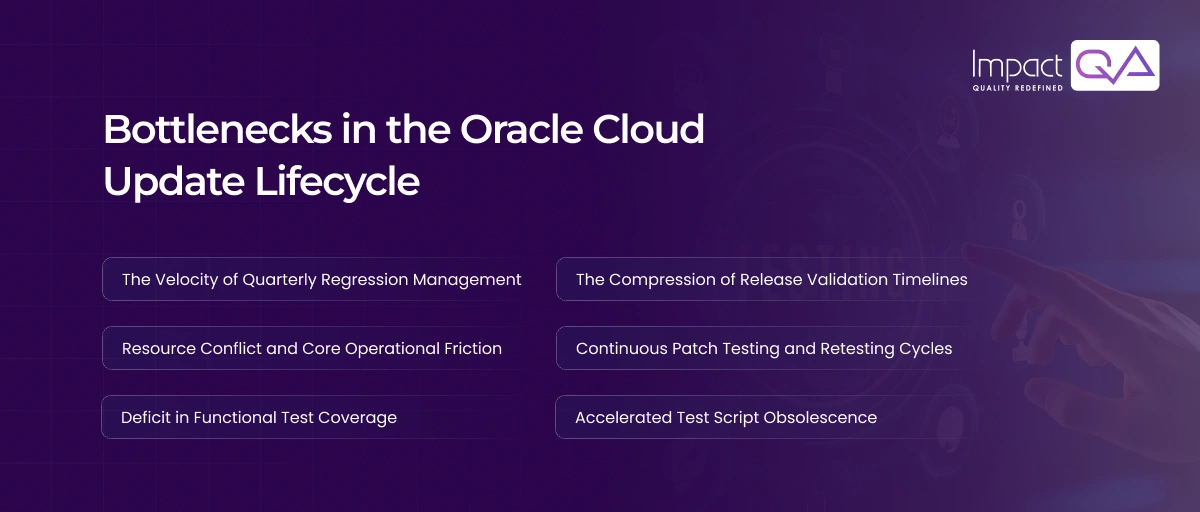
The Velocity of Quarterly Regression Management: Every quarterly release introduces functional updates, bug fixes, and security patches that demand comprehensive regression verification. Quality engineering teams face the immense challenge of ensuring that these mandatory updates do not disrupt highly customized enterprise workflows or break existing data structures.
The Compression of Release Validation Timelines: The mandatory two-week validation window provided for cloud application releases creates a severe operational bottleneck. Forcing comprehensive end-to-end testing into such a restricted timeframe often results in rushed test execution, limited verification scopes, and a significantly higher probability of production defects.
Resource Conflict and Core Operational Friction: Executing extensive testing cycles requires significant time and effort, which frequently drains business analysts and subject matter experts away from their primary operational responsibilities. Striking a sustainable balance between rigorous software validation and daily business continuity remains a constant challenge for modern enterprises.
Continuous Patch Testing and Retesting Cycles: Ongoing patch deployments designed to fix minor system issues frequently trigger unintended consequences across connected software modules. Teams are caught in an endless loop of exploratory testing and retesting to confirm that new fixes do not introduce secondary regression defects.
Deficit in Functional Test Coverage: Given the massive scale and complexity of cloud-based ERP environments, achieving deep test coverage under tight deadlines is exceptionally difficult. This limitation leaves high-risk business processes unverified, creating a hidden vulnerability where critical defects can slip unnoticed into production.
Accelerated Test Script Obsolescence: For organizations utilizing automation, quarterly updates frequently change underlying user interface elements and data schemas. This continuous evolution requires a major overhaul of test scripts, turning routine maintenance into a significant time sink that stalls overall delivery velocity.
Quantifying Operational Risks and Business Disruption
Operating within a cloud-first framework introduces a continuous update cycle that redefines institutional risk management. Oracle delivers mandatory quarterly updates to its cloud applications, offering organizations immediate access to new features and security patches. However, these frequent updates present a substantial operational risk if the software is not verified within tight timeframes. The traditional approach of taking several weeks to manually validate business processes is no longer viable when the update window is restricted to a mere two-week period.
The risk of regression defects escaping into production increases exponentially without a systematic validation approach. A single undetected modification in a financial module or a procurement workflow can disrupt entire global supply chains or halt financial closing procedures. Moreover, custom configurations and personalized extensions built on top of the standard cloud framework are highly susceptible to breaking during automated platform updates. Organizations must, therefore, adopt continuous Oracle software testing practices to systematically verify every business process against the newly deployed update before it hits the live production environment.
Beyond immediate operational disruptions, compliance and regulatory risks loom large for modern enterprises. Industries such as healthcare, finance, and life sciences must adhere to stringent data governance mandates, including GDPR, HIPAA, and SOX. Every software update must be verified to ensure that security configurations, user access privileges, and audit trails remain fully intact. Failure to document comprehensive validation metrics can lead to severe non-compliance penalties, making automated regression validation a foundational requirement for regulatory adherence.
Risk Category |
Operational Impact |
Mitigation Metric |
| Quarterly Update Regression | Breakthrough defects in custom workflows causing systemic business downtime. | 100% automated regression coverage for core modules. |
| Data Governance Breach | Exposure of sensitive operational data during cloud synchronization phases. | Automated data masking and continuous security validation. |
| Integration Failure | Disruption of downstream third-party APIs and financial data pipelines. | Automated end-to-end API testing across all connected nodes. |
| Performance Degradation | Latency in transaction processing times during peak operational hours. | Automated load and scalability testing prior to production release. |
Strategic Frameworks for Modern Oracle Test Automation
Mitigating the technical challenges and operational risks inherent in cloud environments requires a structural shift toward intelligent automation. Relying on manual engineering efforts to validate complex enterprise systems creates immediate deployment bottlenecks and increases the likelihood of human error. Organizations must implement a comprehensive framework for Oracle Cloud automated testing to accelerate validation cycles and ensure continuous software reliability. This strategy requires a modular, maintainable automation architecture capable of adapting to shifting application states without extensive manual script rewriting.
An effective automation strategy begins with building a robust regression suite that focuses on high-risk business processes. Automation engineers should leverage advanced keyword-driven or model-based frameworks to abstract the test logic from the underlying application code, ensuring that changes to user interface elements do not render entire test suites obsolete. Additionally, incorporating Oracle Cloud test automation early in the development and deployment lifecycles allows software teams to discover regression issues immediately. This significantly reduces the cost and effort required for remediation.
Strategic Imperative |
Technical Implementation |
Operational Objective |
| Advanced Test Automation | Deploy resilient, locator-agnostic scripts across dynamic web components. | Minimize script maintenance and eliminate false automation failures. |
| Continuous Integration Alignment | Embed automated validation suites directly into CI/CD deployment pipelines. | Achieve rapid feedback loops during quarterly application updates. |
| Synthetic Data Generation | Programmatically generate diverse, compliant test datasets for realistic validation. | Eliminate dependencies on production data while ensuring compliance. |
Moreover, contemporary test architectures must prioritize API-layer validation alongside user interface testing. Validating applications at the service layer offers significantly faster execution speeds and greater stability than graphical user interface automation alone. By combining user interface validation with comprehensive API testing, enterprises establish a holistic quality assurance framework. This balanced approach ensures complete functional verification across all application layers. This also helps organizations maintain continuous compliance and deliver uninterrupted business operations.
ImpactQA provides robust Oracle Cloud testing solutions to ensure seamless system integration.
The Road Ahead
Navigating the complexities of cloud-first enterprise architectures demands a complete re-engineering of quality assurance methodologies. As organizations continue to migrate vital business operations to cloud environments, traditional manual validation techniques become a primary source of operational vulnerability. Embracing modern Oracle test automation frameworks has now become a fundamental operational requirement. For this reason, enterprises must proactively build scalable, resilient validation strategies to defend against the risks of continuous quarterly update cycles and protect core data workflows across multi-vendor ecosystems.
At ImpactQA, we address these complex engineering challenges through our comprehensive suite of specialized software validation solutions. By utilizing advanced automation frameworks, predictive defect tracking, and meticulous end-to-end regression testing, our team ensures that your core business workflows remain fully operational during major system upgrades and routine patches. Our tailored Oracle testing services allow us to help enterprises accelerate release schedules, protect data integrity across all channels, and maximize their technology investments. Partnering with us for these advanced validation methodologies empowers your organization to secure long-term operational resilience and drive sustainable business transformation.
Share this post


Related Posts
Our Case Studies