How AI is Changing SAP Testing for Enterprises

Quick Summary:
Enterprise SAP environments now demand validation that can respond to constant system change rather than follow fixed execution paths. In this blog, AI is positioned as a shift in how SAP QA testing services interpret risk, prioritize execution, and refine coverage using real system behavior instead of static assumptions. SAP testing services are gradually moving toward adaptive validation models where decision-making is driven by data patterns rather than predefined scripts. This allows for more precise and responsive quality outcomes across complex business systems.
Table of Contents:
- Introduction
- Why Traditional SAP Testing Models Are Reaching Their Limits
- How AI is Redefining SAP Testing Execution
- AI-Driven Advantages Across SAP Testing Layers
- Implementation Challenges and Control Measures
- Final Say
A recent World Quality Report highlights that over 80% of enterprises are adopting AI-driven testing to manage increasing release complexity and system interdependencies. This signals a deeper shift in how enterprise applications are validated. As SAP systems expand across S/4HANA, cloud integrations, and industry modules, testing is no longer confined to validating transactions. It must interpret system behavior, anticipate risks, and align with real operational scenarios.
This raises an important consideration. Can conventional testing approaches keep pace with such complexity without introducing delays or risk exposure? The answer is increasingly uncertain. This is where AI-backed SAP testing services are gaining attention. By embedding intelligence into execution cycles, SAP QA testing services are moving beyond repetitive validation and enabling systems to learn from data, adapt to change, and deliver more accurate outcomes across business-critical processes.
ImpactQA delivers AI-driven SAP testing services that reduce risk and improve release confidence.
Why Traditional SAP Testing Models Are Reaching Their Limits
Enterprise SAP environments have evolved into interconnected ecosystems. Modules interact with third-party platforms, cloud services, and analytics layers, making validation more complex than before. Traditional SAP functional testing relies heavily on predefined scenarios. While this works for stable systems, it struggles when configurations change frequently or when dependencies are not fully visible.
Similarly, SAP regression testing services often involve executing large test suites after every update. This approach consumes time and resources while offering limited insight into actual risk areas. As release cycles shorten, this model becomes difficult to sustain. It introduces delays and increases the likelihood of overlooking critical defects.
SAP integration testing services also face limitations in traditional setups. Predefined scripts cannot always capture real-world data flows across APIs and middleware. This leads to gaps in validation, especially in scenarios involving high transaction volumes or complex system interactions.
Another concern lies in test maintenance. SAP test automation services built on static scripts require continuous updates whenever interfaces or workflows change. This adds operational overhead and reduces efficiency over time.
These limitations are not isolated issues. They indicate a structural gap between how SAP systems operate and how they are tested. Without a shift in approach, enterprises risk slower releases, higher defect leakage, and reduced confidence in system performance.
How AI is Redefining SAP Testing Execution
AI introduces a more adaptive and data-driven approach to SAP validation. Instead of relying solely on predefined inputs, it evaluates system behavior, historical outcomes, and usage patterns to refine testing processes. This significantly improves the effectiveness of SAP functional testing by ensuring that test scenarios reflect real business operations rather than static assumptions.
In SAP regression testing services, AI enables impact-based testing. By analyzing code changes and system dependencies, it identifies which test cases are most relevant for execution. This reduces unnecessary test runs and focuses effort on areas with higher risk. As a result, regression cycles become faster and more targeted.
For SAP integration testing services, AI provides deeper visibility into system interactions. It tracks data movement across connected applications and detects inconsistencies that may not be captured through manual scripting. This ensures that integrations are validated under realistic conditions.
The role of SAP test automation services also changes significantly. AI introduces self-healing capabilities, where test scripts automatically adjust to changes in application interfaces. This reduces maintenance effort and improves execution stability.
Key AI-Driven Capabilities
1. Intelligent Test Prioritization
AI evaluates historical execution data to identify high-risk areas. SAP QA testing services become more focused and ensure that critical functionalities receive greater validation attention.
2. Self-Healing Automation Frameworks
AI-driven SAP test automation services adapt to UI and workflow changes. This reduces script failures and minimizes manual intervention during test maintenance.
3. Predictive Risk Identification
By analyzing defect patterns, AI anticipates potential failure points. This strengthens SAP regression testing services by directing effort toward vulnerable components.
4. Dynamic Test Data Generation
AI generates diverse test data sets based on actual usage trends. This improves SAP functional testing by covering edge cases often missed in traditional approaches.
5. Continuous Testing Integration
AI integrates with CI/CD pipelines and enables ongoing validation. SAP integration testing services and regression processes become continuous rather than periodic.
This transformation shifts SAP testing from a static activity to a responsive system that evolves with the application.
AI-Driven Advantages Across SAP Testing Layers
AI in SAP testing is reshaping how enterprises validate complex systems by moving quality assurance beyond efficiency gains into measurable improvements in precision, coverage, and risk control. Instead of relying on static validation cycles, AI introduces adaptive intelligence that continuously refines testing outcomes across functional, regression, integration, and automation layers. This shift allows enterprises to respond faster to system changes while maintaining stronger control over quality and release stability.
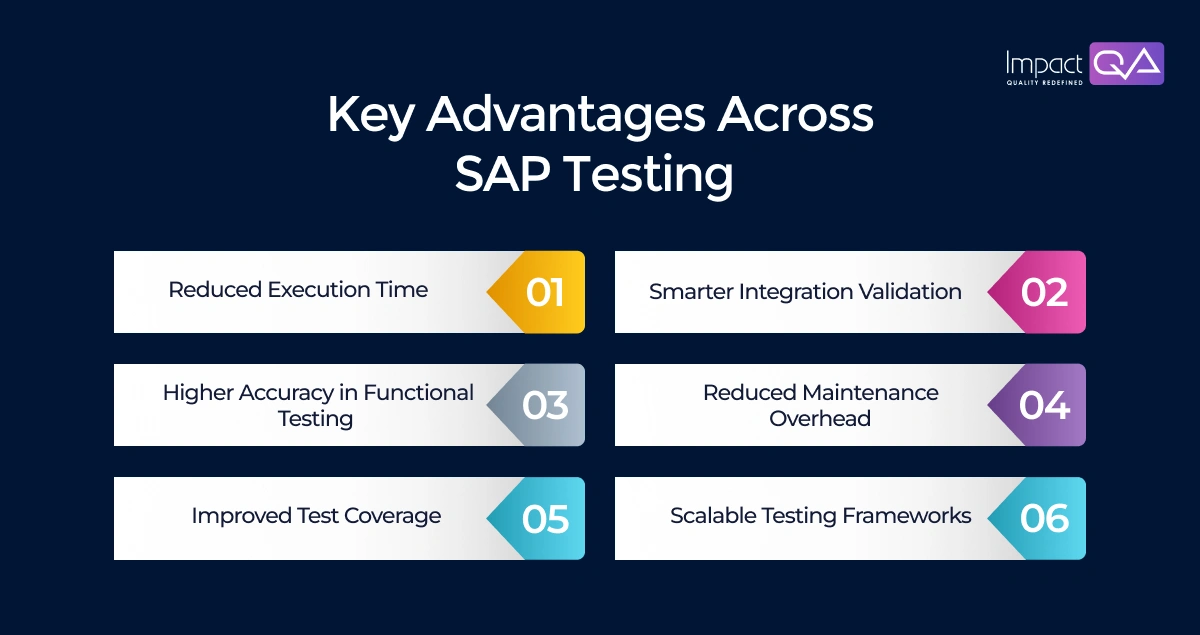
Key Advantages Across SAP Testing
1. Reduced Execution Time
SAP regression testing services become significantly more efficient as AI identifies and removes redundant test cases based on change impact analysis. This reduces overall execution cycles and supports faster release readiness without compromising validation depth.
2. Smarter Integration Validation
SAP integration testing services gain deeper visibility through AI-based monitoring of data flows across interconnected systems. This helps validate complex dependencies more effectively and ensure consistent performance across APIs, middleware, and external applications.
3. Higher Accuracy in Functional Testing
SAP functional testing becomes more aligned with actual user journeys as AI evaluates real usage patterns and system interactions. This ensures test scenarios reflect operational reality rather than predefined assumptions.
4. Reduced Maintenance Overhead
Self-healing SAP test automation services reduce dependency on frequent script updates by automatically adapting to UI and workflow changes. This improves long-term stability and reduces maintenance effort significantly.
5. Improved Test Coverage
AI enhances overall SAP testing services by identifying gaps in existing test suites and generating additional scenarios based on real-world data patterns. This ensures broader and more meaningful coverage across business processes.
6. Scalable Testing Frameworks
AI-driven models adapt to system growth and complexity, ensuring SAP integration testing services remain reliable even as enterprise ecosystems expand across multiple platforms and technologies.
Implementation Challenges and Control Measures
Despite its benefits, AI adoption in SAP testing requires careful planning. One of the primary challenges is aligning AI models with enterprise-specific processes. SAP systems are highly customized, and generic models may not accurately reflect business workflows. This makes it essential to define clear objectives within SAP test strategy services.
Data quality is another critical factor. AI systems rely on accurate and consistent data to generate reliable insights. Incomplete datasets can affect the effectiveness of SAP regression testing services and SAP integration testing services. Enterprises must establish strong data governance practices to address this issue.
Skill gaps also present a challenge. Testing teams need to understand how AI models function and how to interpret their outputs. This requires training and a shift in mindset from execution-focused roles to analytical roles.
Control Measures for Effective Adoption
1. Define Clear Testing Objectives
Establish goals within SAP test strategy services to guide AI implementation and ensure alignment with business priorities. This clarity helps in prioritizing use cases and avoids unnecessary complexity during early adoption stages.
2. Use SAP Automated Testing Tools Selectively
Focus on high-impact areas rather than applying AI across all processes. This ensures better control and measurable outcomes. A phased approach also allows teams to validate results before expanding AI adoption across broader SAP environments.
3. Build Continuous Feedback Loops
Refine AI models using execution data. This improves accuracy and strengthens SAP QA testing services over time. Regular feedback integration also helps in identifying gaps and improving model reliability with each testing cycle.
4. Partner with the Best SAP Testing Services Provider
Expert guidance ensures proper implementation and helps scale AI-driven SAP testing services effectively. It also brings structured methodologies and domain expertise that accelerate adoption while minimizing implementation risks.
ImpactQA applies intelligent automation to streamline testing and reduce maintenance effort.
Final Say
AI is redefining SAP testing by introducing intelligence into every stage of validation. It shifts testing from a repetitive process to a data-driven system that adapts to change, identifies risks, and improves continuously. As SAP environments become more complex, this transformation is essential for maintaining system stability and operational efficiency. Enterprises that adopt AI-driven SAP QA testing services and SAP regression testing services are better equipped to manage frequent updates and complex integrations.
The role of SAP integration testing services and SAP test automation services is also expanding, supporting continuous validation across interconnected systems. This ensures that testing keeps pace with development without compromising quality. Organizations that invest in structured AI adoption are building more resilient testing frameworks that align with business requirements.
ImpactQA positions itself as a dependable partner in this transition. Through our advanced SAP testing services, we bring AI-driven methodologies into SAP functional and regression testing. Our approach is centered on precision, adaptability, and measurable outcomes. By blending deep domain expertise with intelligent automation, we enable enterprises to build efficient, scalable, and future-ready SAP testing frameworks.
Share this post


Related Posts
Our Case Studies