Choosing the Right Oracle Software Testing Strategy for Complex Integrations

Quick Summary:
Integration failures in Oracle environments rarely originate within a single application; they occur where Oracle ERP, SCM, and third-party systems interact during updates and batch processing. This blog examines how Oracle testing strategies must validate API contracts, data mapping and transformation rules, and end-to-end workflows using Oracle Cloud testing and automation to maintain consistency across tightly integrated systems.
Table of Contents:
- Introduction
- Complex Oracle Integrations and Testing Challenges
- Strategic Approaches to Oracle Testing for Integrated Systems
- Benefits of a Structured Oracle Cloud Test Automation Framework
- Best Practices for Implementing Oracle Testing at Scale
- Conclusion
Modern enterprises rely heavily on Oracle ecosystems to manage finance, supply chains, and customer operations. However, the increasing number of integrations across ERP, CRM, and third-party platforms introduces significant testing complexity. Oracle testing now extends beyond standalone module validation to verifying cross-application workflows, data integrity across systems, and the impact of continuous updates within Oracle Cloud testing environments.
As organizations adopt cloud-first strategies, the need for Oracle Cloud automated testing becomes more evident. Testing teams must ensure that integrations remain stable even as APIs evolve and configurations change. A well-defined Oracle in software testing strategy allows enterprises to validate not only functionality but also data consistency, performance, and security across systems. Without such an approach, integration failures can disrupt critical business processes and lead to costly rework.
ImpactQA applies intelligent Oracle Cloud automated testing to improve system reliability.
Complex Oracle Integrations and Testing Challenges
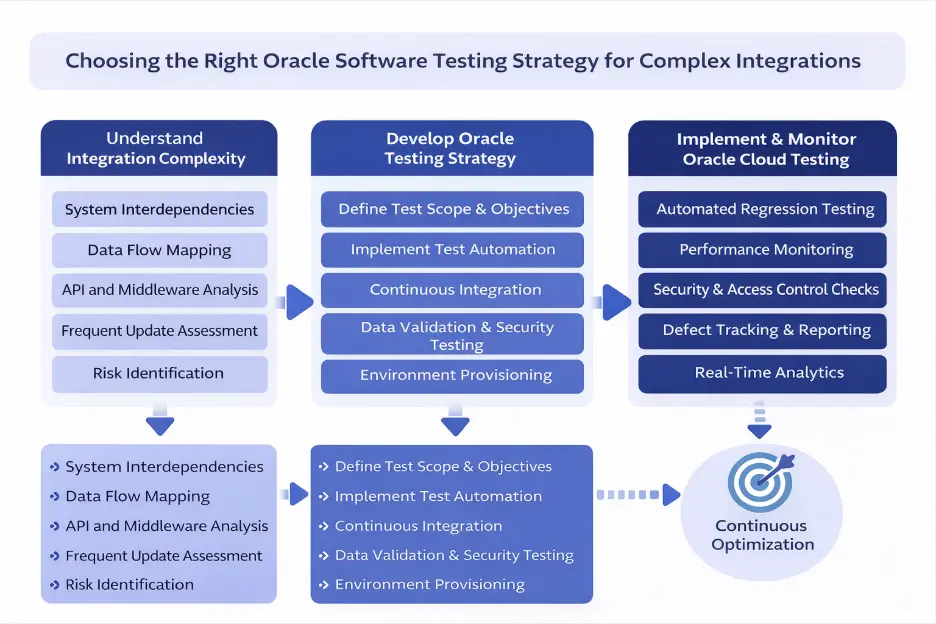
Complex Oracle ecosystems often involve multiple interconnected applications such as Oracle ERP Cloud, Oracle SCM, and third-party platforms. These integrations rely on APIs, middleware, and data pipelines, making testing significantly more demanding. Oracle testing in such environments must go beyond standard validation to ensure seamless interaction between systems.
One of the primary challenges is data synchronization across systems. When data flows between Oracle applications and external platforms, even minor inconsistencies can lead to transaction failures or reporting errors. This makes Oracle Cloud testing a continuous process rather than a one-time activity. Testing teams must validate data integrity at every integration point.
Another major concern is frequent updates and patches. Oracle releases quarterly updates and monthly patches, which can impact existing integrations. Without Oracle Cloud automated testing, manually validating every workflow becomes inefficient and prone to errors. Automated regression testing ensures that updates do not break existing functionality.
Integration environments also face complex dependency mapping. For instance:
- Changes in one module may impact multiple downstream systems.
- Middleware configurations can introduce latency or transformation errors.
- API version updates may disrupt existing connections.
These dependencies require a structured Oracle Cloud test automation approach that continuously validates end-to-end workflows.
Additionally, performance and scalability issues must be addressed. Integrated systems often process high volumes of transactions simultaneously. Oracle in software testing must include performance validation to ensure that integrations can handle peak loads without delays or failures.
Security is another critical factor. With sensitive enterprise data moving across systems, testing must verify access controls, encryption, and compliance requirements. This adds another layer of complexity to Oracle testing strategies.
Finally, organizations often struggle with limited visibility into integration failures. Without proper monitoring and reporting, identifying the root cause of issues becomes time-consuming. This highlights the need for intelligent Oracle cloud automated testing frameworks that provide actionable insights.
Strategic Approaches to Oracle Testing for Integrated Systems
To address the challenges of complex integrations, organizations must adopt a strategic approach to Oracle testing. This involves combining manual expertise with advanced automation techniques to ensure comprehensive validation.
1. End-to-End Integration Testing
Testing should focus on complete business workflows rather than isolated components. This ensures that data flows correctly across all systems. Oracle Cloud testing must validate:
- Upstream and downstream data dependencies
- API communication between systems
- Business process continuity
This approach reduces the risk of integration failures during production.
2. API-Centric Testing Strategy
Since integrations rely heavily on APIs, testing must prioritize API validation. Oracle Cloud automated testing enables teams to:
- Validate request and response structures
- Test error handling mechanisms
- Ensure compatibility across API versions
This strengthens the reliability of integrations and improves system resilience.
3. Regression Testing Automation
Frequent Oracle updates require repeated validation of existing workflows. Oracle Cloud Test Automation ensures that regression testing is executed efficiently without manual effort. Automated test suites can quickly identify defects introduced by new updates.
4. Data Validation and Reconciliation
Data accuracy is critical in integrated systems. Oracle testing strategies must include:
- Data comparison across source and target systems
- Validation of transformation logic
- Monitoring of data consistency
This ensures that business decisions are based on accurate information.
5. Environment Management and Test Data Strategy
Testing complex integrations requires stable environments and realistic data. Organizations must:
- Maintain synchronized test environments
- Use masked production data for accuracy
- Automate environment provisioning
This improves the effectiveness of Oracle in software testing and reduces testing delays.
6. Continuous Testing within CI/CD Pipelines
Modern enterprises integrate testing into their development pipelines. Oracle Cloud automated testing enables continuous validation of integrations during development cycles. This approach ensures early defect detection and faster release cycles.
Benefits of a Structured Oracle Cloud Test Automation Framework
Implementing a well-defined Oracle Cloud test automation framework provides measurable benefits for enterprises managing complex integrations. It transforms testing from a reactive activity into a proactive quality assurance process.
Improved Release Confidence
Automated testing ensures that all integration points are validated before deployment. Oracle cloud testing provides detailed insights into system behavior, enabling teams to release updates with confidence.
Faster Testing Cycles
Manual testing of integrated systems can be time-consuming. Oracle Cloud automated testing accelerates test execution, allowing organizations to meet tight release timelines without compromising quality.
Enhanced Accuracy and Consistency
Automation eliminates human errors in repetitive testing tasks. Oracle testing frameworks ensure consistent validation of workflows, reducing the risk of defects in production.
Better Risk Management
By continuously validating integrations, organizations can identify potential risks early. Oracle in software testing enables teams to address issues before they impact business operations.
Scalability for Growing Systems
As enterprises expand their Oracle ecosystems, testing requirements increase. Oracle Cloud test automation provides the scalability needed to handle complex and large-scale integrations.
Cost Optimization
Although automation requires initial investment, it reduces long-term testing costs by minimizing manual effort and preventing costly production failures.
Key Area |
Without Automation |
With Oracle Cloud Test Automation |
| Regression Testing | Time-consuming, error-prone | Fast and consistent |
| Integration Validation | Limited Coverage | Comprehensive validation |
| Release Cycles | Delayed | Accelerated |
| Risk Detection | Reactive | Proactive |
ImpactQA delivers scalable Oracle Cloud test automation tailored to enterprise needs.
Best Practices for Implementing Oracle Testing at Scale
To maximize the effectiveness of Oracle testing strategies, organizations must follow best practices that align with their integration complexity and business goals. This requires a structured approach that combines process standardization, intelligent automation, and continuous validation to maintain stability across interconnected Oracle environments.
1.Build a Modular Test Architecture
Breaking down test cases into reusable components improves maintainability. Oracle Cloud testing frameworks should allow easy updates when system changes occur.
2. Prioritize Critical Business Flows
Not all integrations require the same level of testing. Focus on high-impact workflows that directly affect business operations. This ensures efficient use of testing resources.
3. Combine Manual and Automated Testing
While Oracle Cloud automated testing handles repetitive tasks, manual testing is essential for exploratory scenarios and usability validation. A balanced approach improves overall test coverage.
4. Implement Continuous Monitoring
Testing should not end after deployment. Continuous monitoring helps detect integration issues in real time, ensuring system stability.
5. Use Advanced Reporting and Analytics
Detailed reports provide insights into test coverage, defect trends, and system performance. This enables data-driven decision-making in Oracle in software testing.
6. Ensure Collaboration Across Teams
Successful testing requires coordination between developers, testers, and business stakeholders. Clear communication ensures that integration requirements are fully understood and validated.
Conclusion
Choosing the right Oracle testing strategy for complex integrations requires a clear understanding of system dependencies, data flows, and update cycles. Organizations must adopt a structured approach that combines Oracle Cloud testing with automation and continuous validation. This ensures that integrations remain stable, scalable, and aligned with business objectives. A strong Oracle Cloud automated testing framework gives teams the ability to validate cross-application workflows before failures surface in production and maintain consistent performance across interconnected systems.
ImpactQA stands out as one of the best test automation service providers with deep expertise in Oracle ecosystems. Our approach to Oracle testing focuses on validating complex integrations across Oracle ERP, SCM, and third-party systems, automating regression for quarterly updates, and ensuring data consistency across workflows. With Oracle Cloud test automation accelerators and CI/CD-aligned execution, we help enterprises shift to a more controlled and integration-focused QA model with greater visibility into integration risks and tighter control over deployment quality.
Share this post


Related Posts
Our Case Studies